
accepting new subscribers
$ whoami
frontend eng, anime addict, mediocre cook
$ cat today.log
▍
$ ./subscribe.sh
Get new posts by email:
No spam. One email a week, max. Unsubscribe anytime.

Done Nandi Hills, Coorg and the usual weekend spots around Bengaluru? There is still plenty to explore. From quiet forts and forested hills to coffee country, rivers, rainforests and places that feel like an alternative to Ooty or Munnar, these 10 lesser known escapes can be reached by car, bike, bus or train within roughly 7 hours of Bengaluru.

Want to travel solo but your parents immediately start imagining every possible disaster? Here are 12 places around India where your trip can be about more than just sightseeing. From the peaceful mountains of Kedarnath to the beaches of Somnath and the landscapes around Rameshwaram, these Jyotirlinga destinations combine spirituality, nature, food, culture and travel experiences that might just make your parents say, “Okay, you can go.”

Looking for a relaxed beach getaway that still gives you something fun to do? Mulki, near Mangaluru, is a great little escape for surfing, kayaking, coastal food, peaceful beaches and the chance to see bioluminescent water at night. Here's what makes Mulki worth the trip, what to do, when to go and how to make the most of it without spending a fortune.

Thinking about a trip to Lakshadweep? Before you book your tickets, here's what you should know about permits, islands, transport, weather, water activities, food, cash, packing and a few surprisingly cool things you probably won't find in the usual travel reels.

The title of Kage is reserved for the leaders of the world's strongest hidden villages, but being a Kage doesn't automatically make everyone equal. Throughout Naruto, we've seen Kage with monstrous physical strength, forbidden techniques, legendary Kekkei Genkai, incredible speed, and enough chakra to reshape entire battlefields. From the Third Raikage who fought an entire army alone to Hashirama Senju, the legendary God of Shinobi, and Naruto Uzumaki, who eventually reached a completely different level of power, let's count down the ten strongest Kage in Naruto.
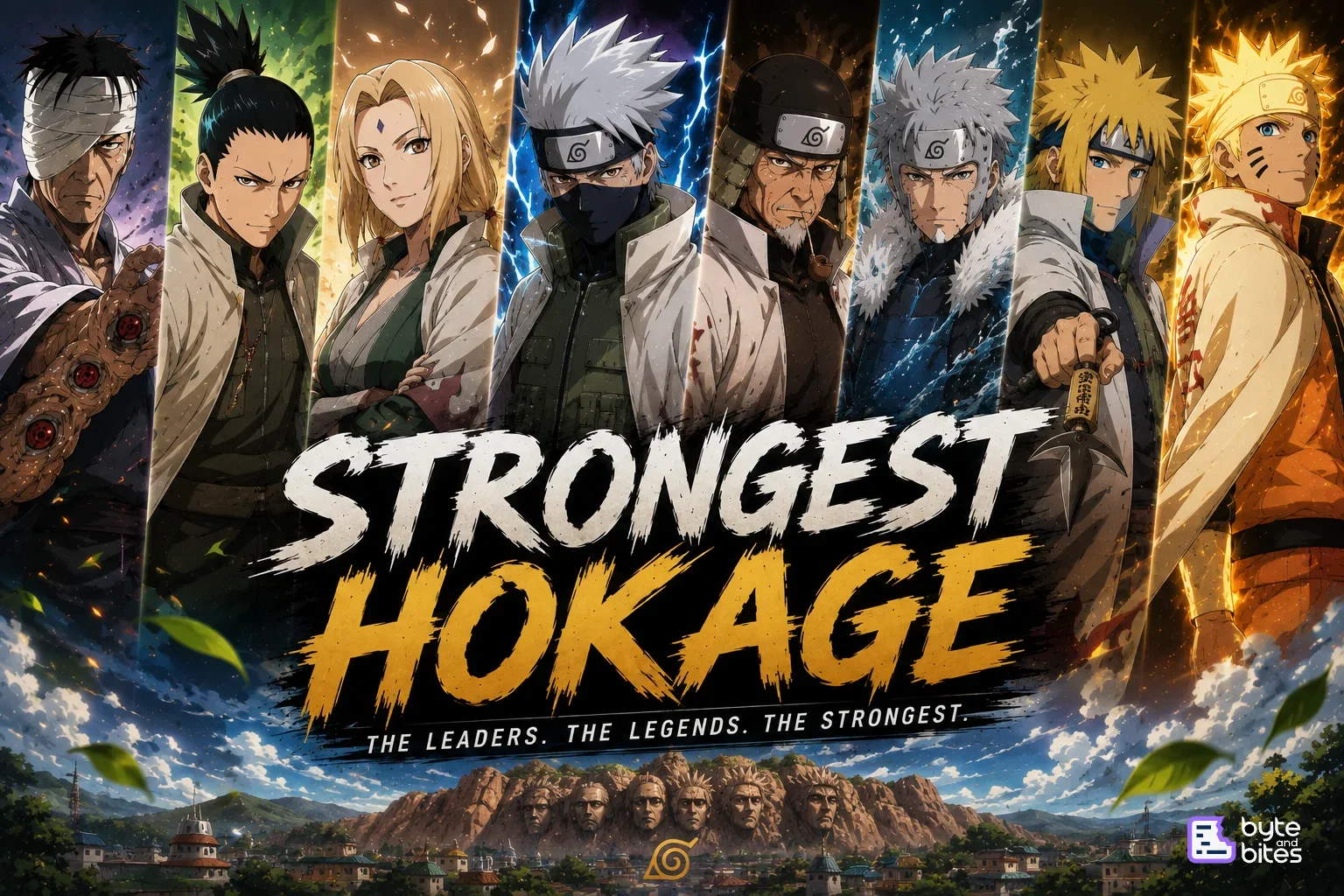
The Hokage is supposed to be the strongest and most capable shinobi in the Hidden Leaf Village, responsible for protecting Konoha and leading it through its most dangerous moments. Across generations, the village has produced legendary leaders such as Hashirama, Tobirama, Minato, Hiruzen, and Naruto. Each Hokage brought something different to the position, from overwhelming strength and forbidden techniques to genius-level strategy and leadership. But who was actually the strongest? Let's count down the most powerful Hokage and see who truly deserves the title of Konoha's greatest leader.

Naruto is filled with powerful shinobi, but behind almost every great ninja is a great teacher. From Kakashi teaching Team 7 to Jiraiya helping Naruto master the Rasengan and understand what being a shinobi really means, the sensei of Naruto played a huge role in shaping the story. Some taught techniques, some taught discipline, and others became almost parental figures to their students. But who was the best teacher in the series? Let's count down the ten most memorable and influential Naruto sensei.

Bankai represents the ultimate release of a Zanpakuto and is one of the most iconic power-ups in Bleach. Over the years, we've seen Bankai that rely on overwhelming destruction, absolute defense, manipulation of the battlefield, freezing temperatures, poison, and even abilities that can completely rewrite how a fight works. With the Thousand-Year Blood War revealing some of the most absurd Bankai in the series, ranking them has become harder than ever. Here are our picks for the ten most powerful Bankai in Bleach, based on their abilities, feats, versatility, and overall combat potential.

Bleach has one of the most ridiculous power scales in anime. What starts with Soul Reapers fighting Hollows eventually expands into captains, Arrancar, Quincy, Royal Guard members, transcendent beings, and powers capable of changing the structure of reality itself. With the Thousand-Year Blood War revealing some of the strongest characters in the entire series, ranking them has become even harder. From legendary Soul Reapers to the terrifying Quincy King, here are the ten strongest Bleach characters of all time.

Hunter × Hunter isn't your typical shounen anime. One arc feels like a survival adventure, the next becomes a tournament, another turns into a crime thriller, and suddenly you're watching one of the darkest examinations of humanity in anime. Yoshihiro Togashi constantly reinvents the series without losing the characters at its heart. From Gon's first Hunter Exam to the unforgettable Chimera Ant conflict, we're counting down the ten best Hunter × Hunter storylines based on their fights, characters, emotional impact, world-building, and overall storytelling.

Anime has given us some of the greatest villains in fiction. Some are terrifying because of their overwhelming power, while others are dangerous because of their intelligence, ideology, manipulation, or sheer unpredictability. The best villains don't simply stand in the hero's way. They challenge their beliefs and change the entire story around them. From legendary shounen antagonists to psychologically disturbing masterminds, these ten villains have left an unforgettable mark on anime history.

Jujutsu Kaisen is filled with sorcerers who can bend reality, manipulate cursed energy, and turn seemingly simple techniques into deadly weapons. From the legendary Sukuna and Gojo to the new generation of monsters like Yuta and Yuji, the series constantly raises the question of who is truly the strongest. But raw cursed energy isn't everything. Domain Expansion, Reverse Cursed Technique, battle IQ, versatility, and experience can completely change the outcome of a fight. Here are the ten strongest sorcerers in Jujutsu Kaisen.

The Hashira are the strongest swordsmen in the Demon Slayer Corps, each specializing in a unique Breathing Style and possessing years of experience fighting demons. But being a Hashira doesn't mean everyone is equally powerful. Some possess overwhelming physical strength, others rely on speed and technique, while a few become terrifyingly powerful after awakening the Demon Slayer Mark. From the legendary Stone Hashira Gyomei Himejima to the incredibly fast Shinobu Kocho, let's rank all nine Hashira based on their strongest versions, combat ability, achievements, and overall fighting potential.

The Akatsuki is one of the most iconic villain organizations in anime history. Made up of rogue shinobi with terrifying abilities, the group brought together some of the strongest and most dangerous characters in Naruto. From legendary Uchiha to immortal fighters and deadly tacticians, every member had a unique ability that made them a serious threat. But who was actually the strongest? Let's rank the ten most powerful Akatsuki members based on their abilities, battle experience, intelligence, and overall combat potential.
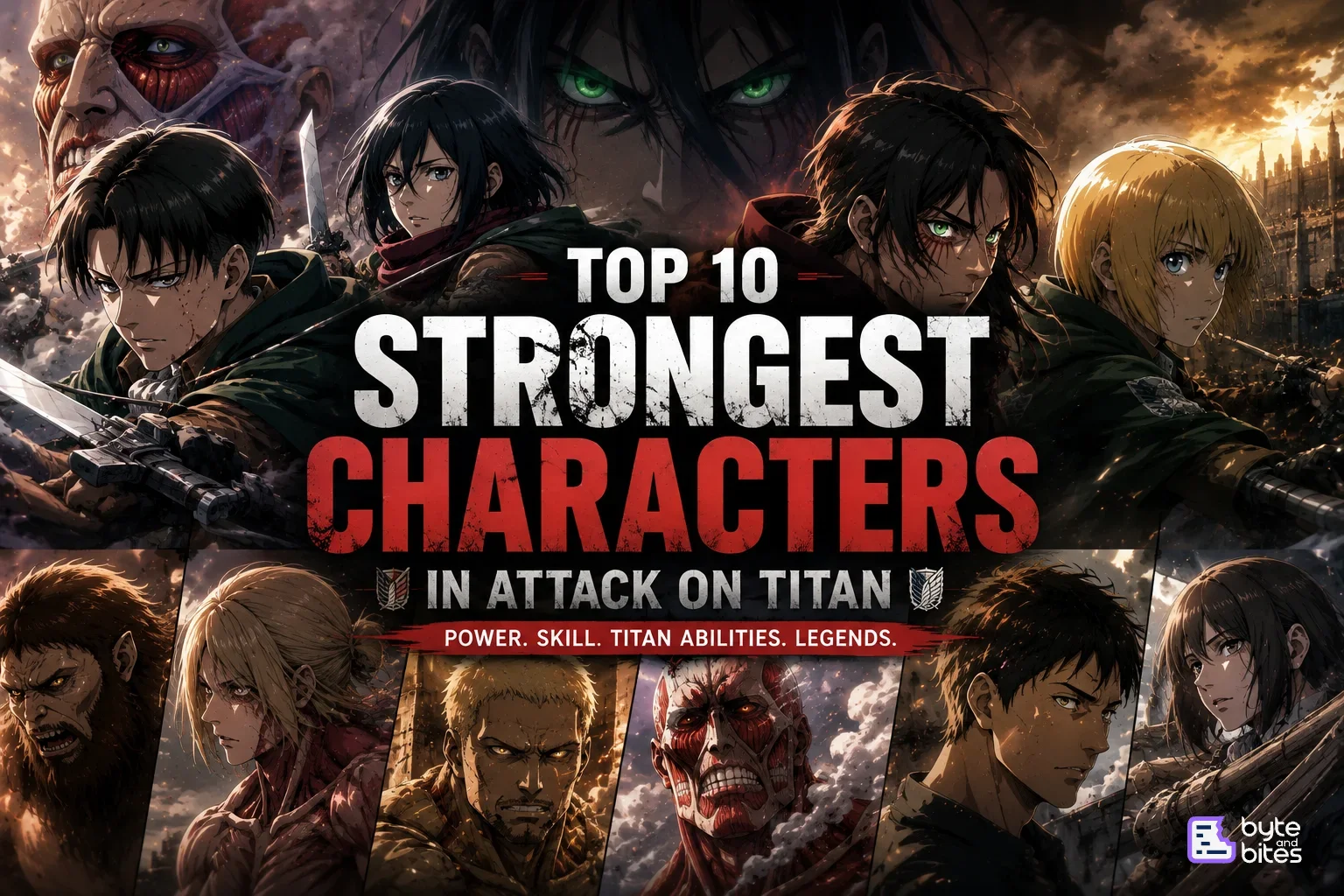
Attack on Titan is filled with terrifying Titans, elite soldiers, legendary warriors, and characters capable of changing the course of history. From the original Founder Ymir to Eren Yeager's terrifying final form, the series constantly raises the question of who is truly the strongest. But raw Titan size isn't everything speed, combat experience, intelligence, regeneration, Titan abilities, and mastery of the battlefield all play a role. Here are the ten strongest characters in Attack on Titan, ranked by their overall combat ability and impact on the story.

Hunter × Hunter features one of the most balanced and strategic power systems in anime. Unlike many shounen series, victory isn't determined solely by raw strength but also by intelligence, Nen mastery, experience, and strategy. From legendary Hunters to terrifying Chimera Ants and elite assassins, these characters have demonstrated overwhelming power that changed the course of the story. Here's our ranking of the ten strongest Hunter × Hunter characters.

Some anime entertain us, while others leave a lasting emotional scar. Whether it's heartbreaking farewells, unforgettable friendships, tragic love stories, or the harsh realities of life, these series and films have moved millions of fans to tears. If you're looking for anime that will stay with you long after the credits roll, these ten masterpieces deserve a place on your watchlist. Just make sure you have a box of tissues nearby.

Anime has given us countless unforgettable moments, but nothing hits harder than saying goodbye to a beloved character. Some deaths changed the entire story, while others left millions of fans in tears for weeks. Whether they sacrificed themselves for others, died chasing their dreams, or simply met a tragic fate, these characters proved that great storytelling isn't afraid to break our hearts. Here are the ten saddest anime deaths that continue to leave a lasting impact on fans around the world.

Some anime characters divide the fandom, while others win the hearts of almost everyone. Whether it's their kindness, loyalty, humor, or unforgettable sacrifices, these characters have earned universal admiration across the anime community. From legendary mentors to lovable companions, here are ten anime characters who are almost impossible to hate.

Not every anime legend is the main protagonist. Sometimes, it's the mentor, rival, comic relief, or even the villain who leaves the biggest impression. These unforgettable supporting characters captured our hearts with their personalities, incredible fights, emotional moments, and unforgettable quotes, often overshadowing the heroes themselves. Here are ten anime side characters who completely stole the spotlight and became fan favorites.

2026 has been an incredible year for anime fans. From long-awaited sequels and blockbuster shounen titles to exciting new originals, this year has something for everyone. Whether you're a newcomer looking for your next binge-worthy series or a longtime anime fan keeping up with the latest releases, these are the ten anime that deserve a place on your watchlist. Here's our ranking of the best anime to watch in 2026.
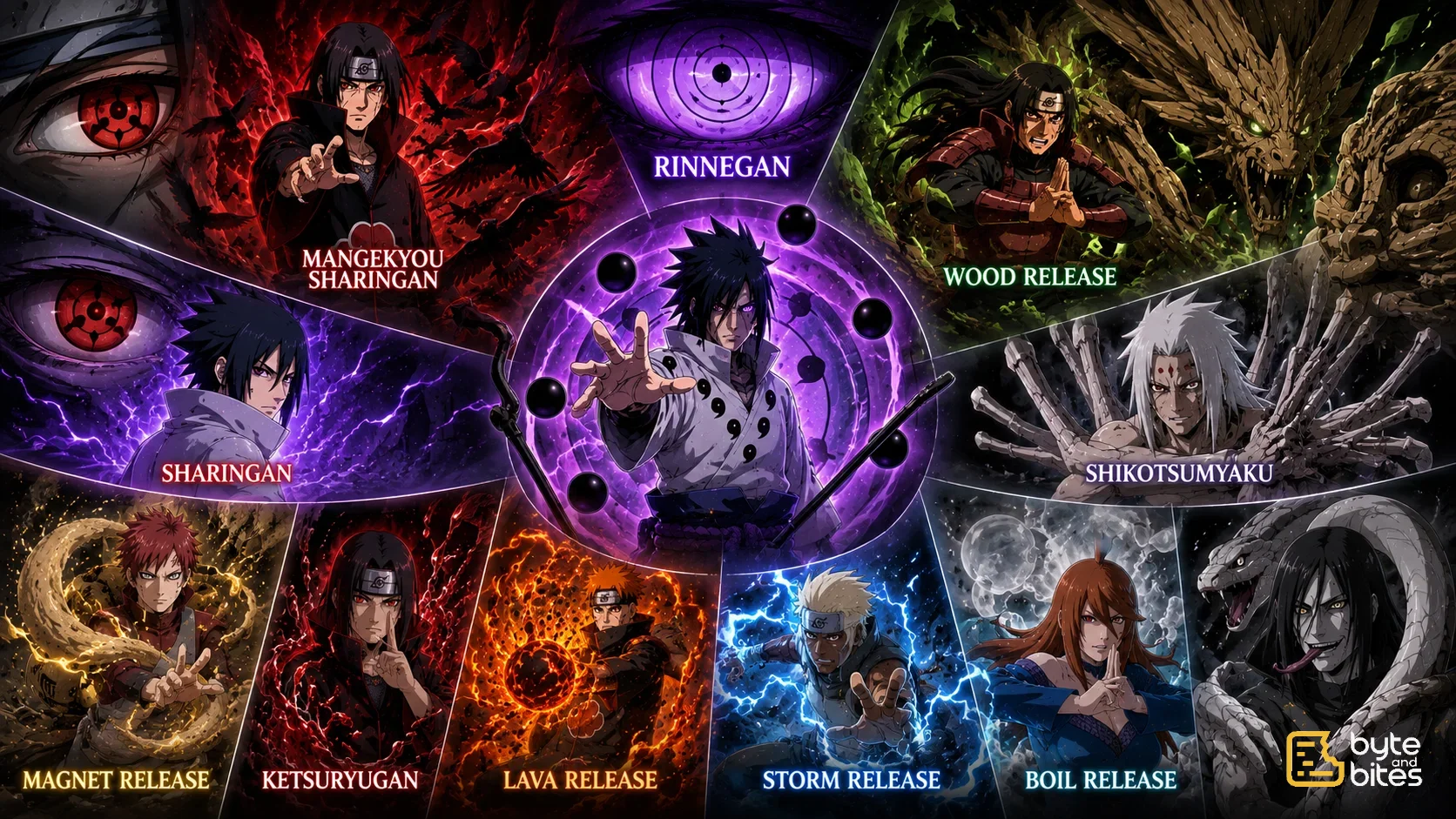
Kekkei Genkai are among the rarest and most fascinating abilities in the Naruto universe. Unlike ordinary jutsu, these bloodline techniques are inherited genetically, making them unique to specific clans or individuals. From legendary Dojutsu like the Rinnegan and Sharingan to powerful elemental combinations like Wood Release and Lava Release, Kekkei Genkai have shaped some of the greatest battles in the series. Here's our ranking of the ten strongest Kekkei Genkai in Naruto and why they stand above the rest.
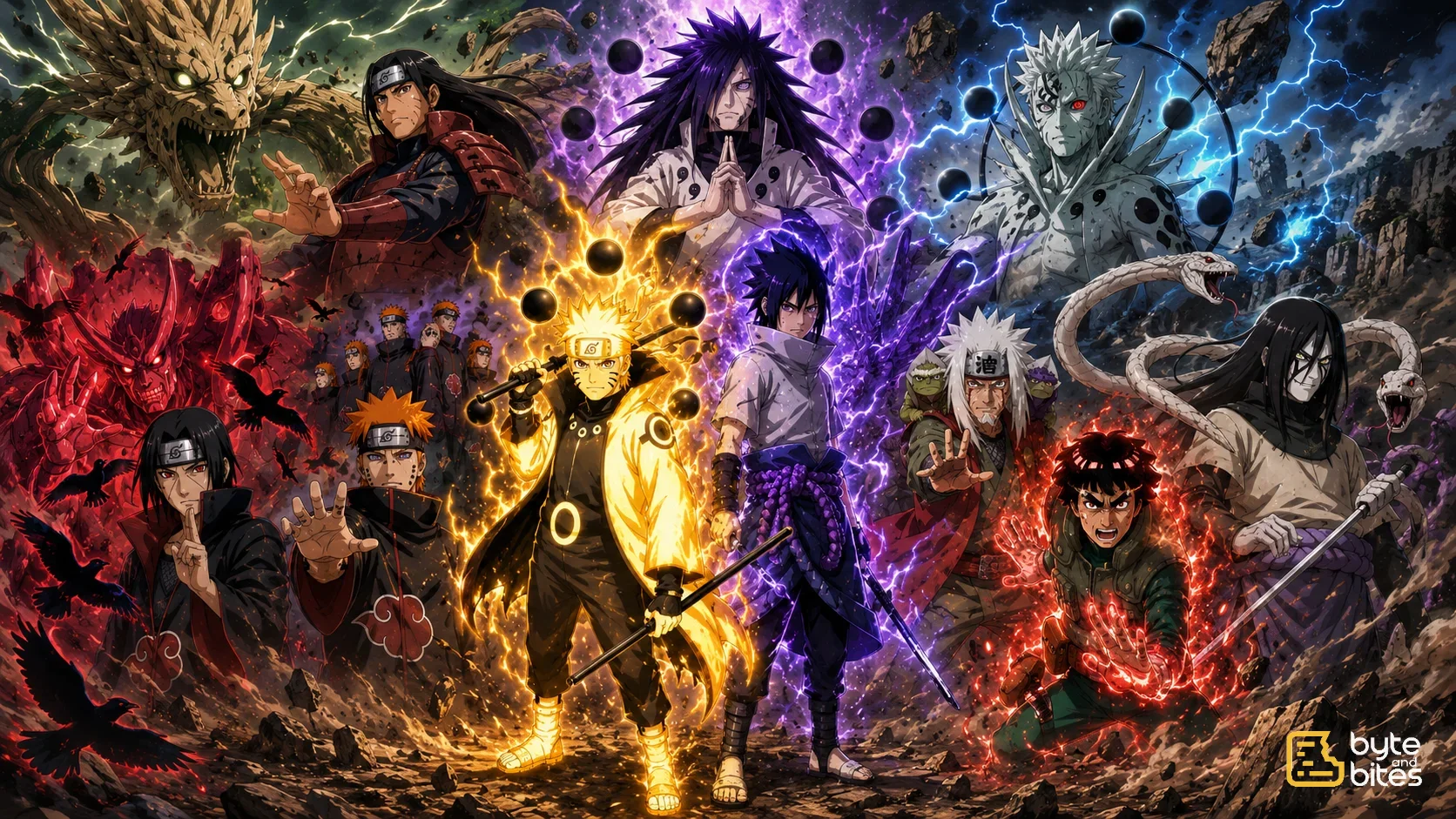
The Naruto universe is home to some of the most powerful shinobi ever created. From legendary Hokage and god-like Uchiha to fearsome Akatsuki members, every character has left a lasting mark on the series. While strength can always be debated depending on the situation, these characters consistently stand out because of their abilities, battle achievements, intelligence, and influence on the story. Here's our ranking of the ten strongest Naruto characters who changed the fate of the shinobi world.

Think anime is only about action and fights? Think again. These 10 romantic anime bring out the emotional side of storytelling with love, heartbreak, and unforgettable characters that stay with you long after the story ends.

Shounen anime is the heart of the anime world, filled with action, growth, friendships, and unforgettable journeys. From classic legends to modern masterpieces, these anime have shaped the genre and inspired millions of fans worldwide. Whether you love intense battles, emotional character development, or epic adventures, this list brings together the best shounen anime you absolutely cannot miss.
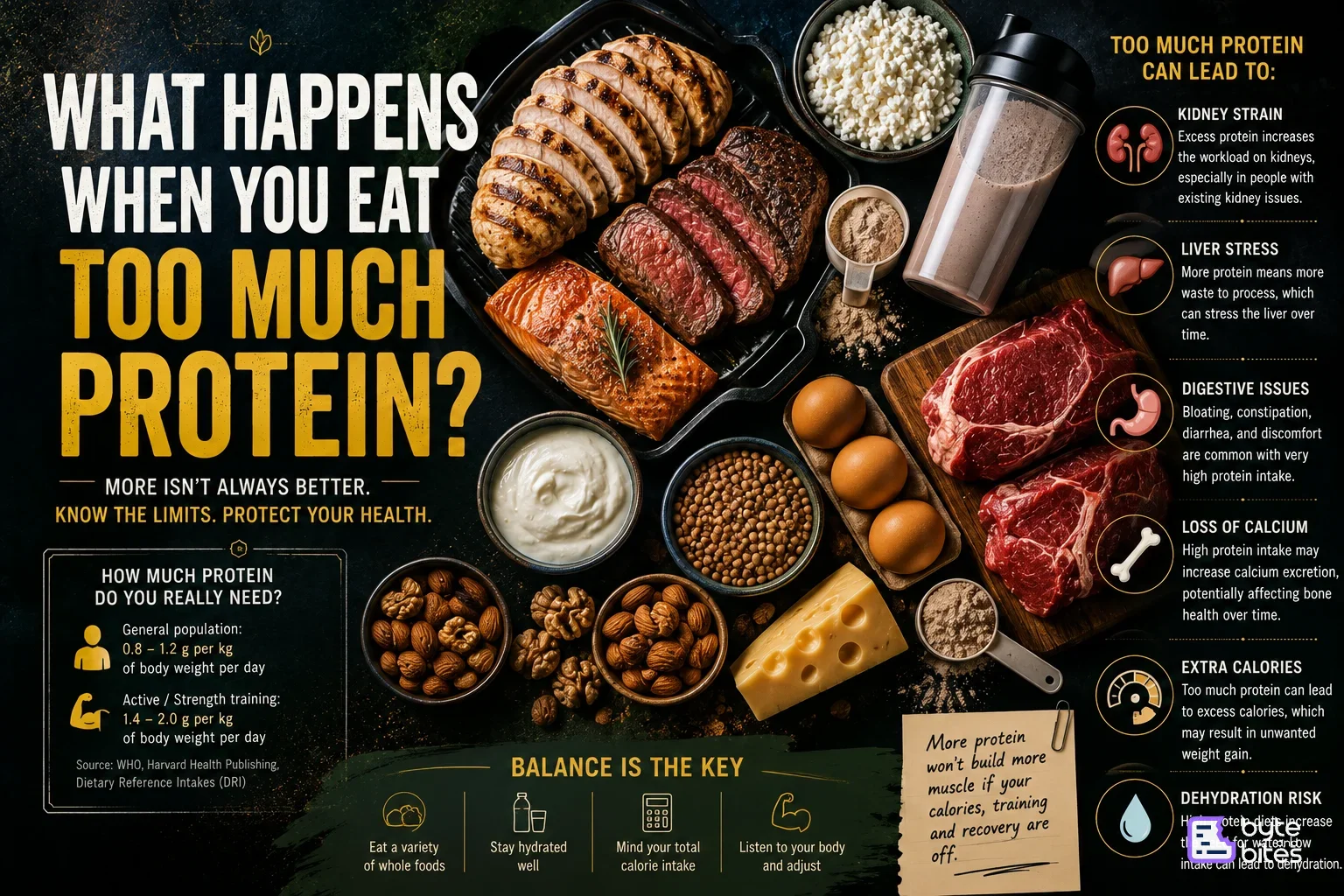
Protein is essential, but the internet has turned "more" into "better." This article looks at what your body does with excess protein, whether high-protein diets actually damage healthy kidneys, the possible downsides of going overboard, and how to find a sensible protein target.

Alcohol can affect far more than your liver. It changes brain activity, sleep, digestion, metabolism, heart function, and immune response. This guide explains what happens after you drink, why alcohol makes you feel the way you do, and what regular drinking can mean for your health.
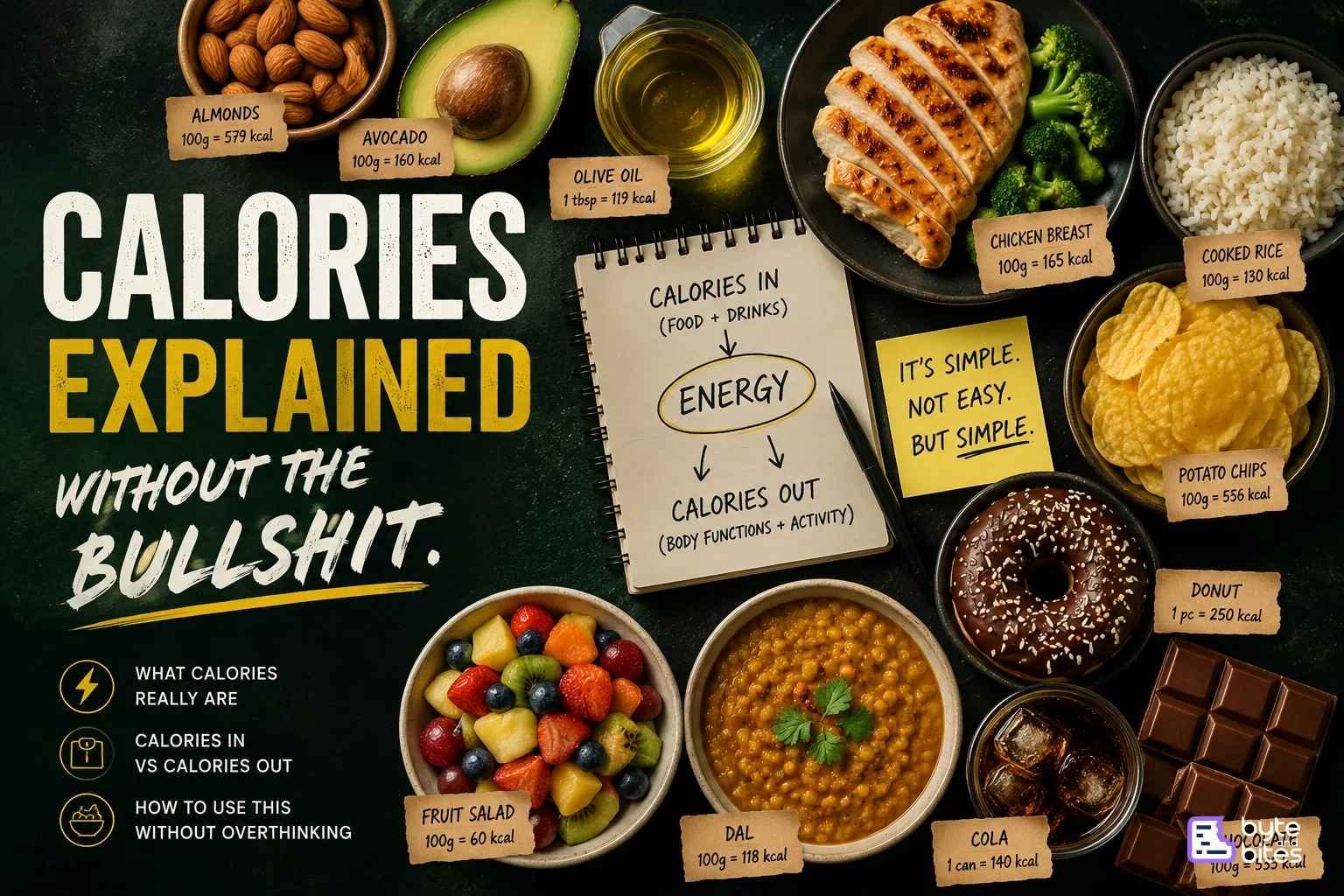
Calories are often treated as either the villain or the secret to weight loss. The reality is simpler. This guide explains what calories actually mean, how your body uses energy, what calorie deficit and surplus really mean, and why food quality still matters beyond the numbers.
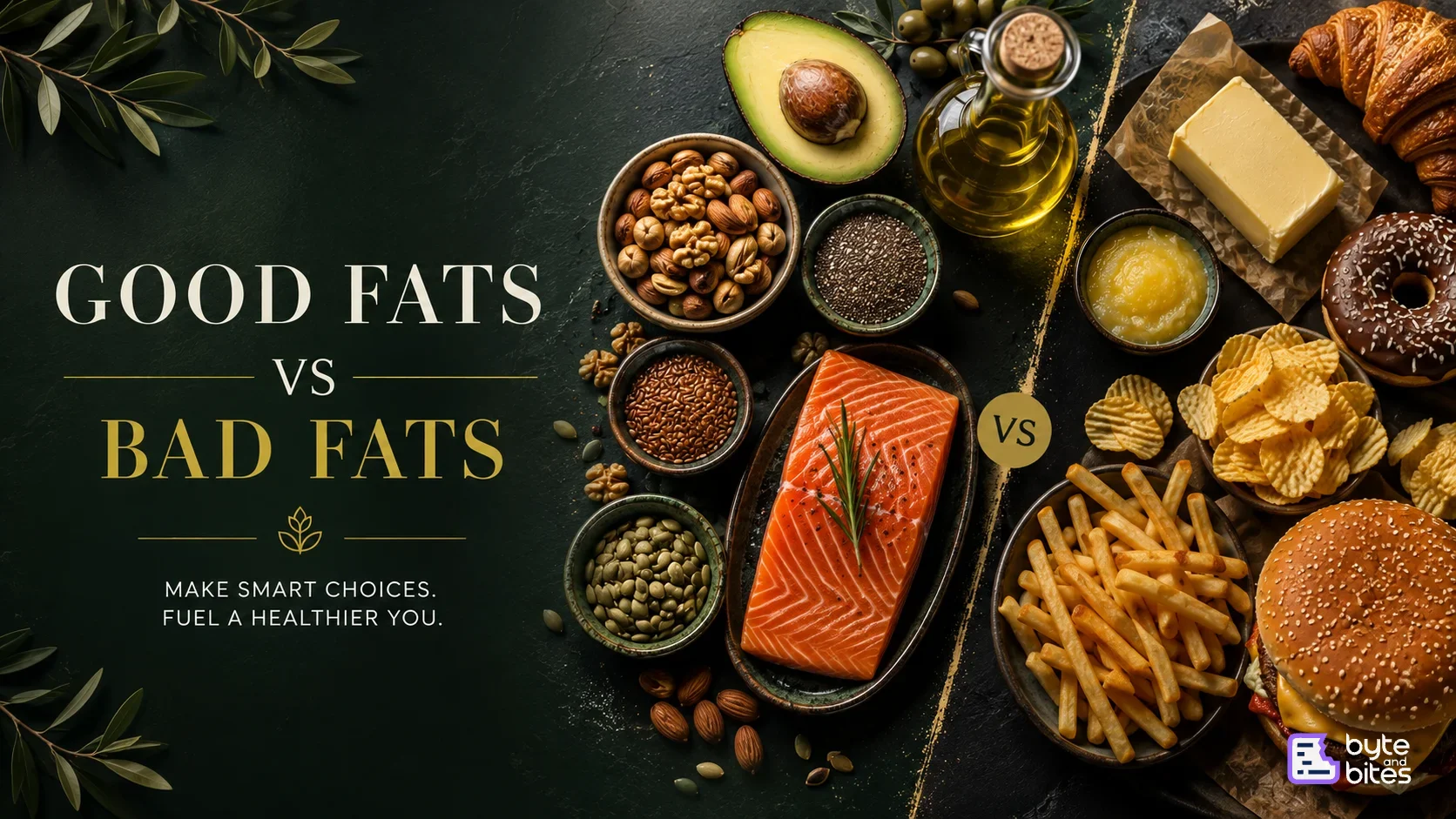
Fat has had a bad reputation for decades, but not all fats are the same. This guide explains the difference between unsaturated, saturated, and trans fats, what to know about ghee and cooking oils, and how to make better fat choices without eliminating them from your diet.
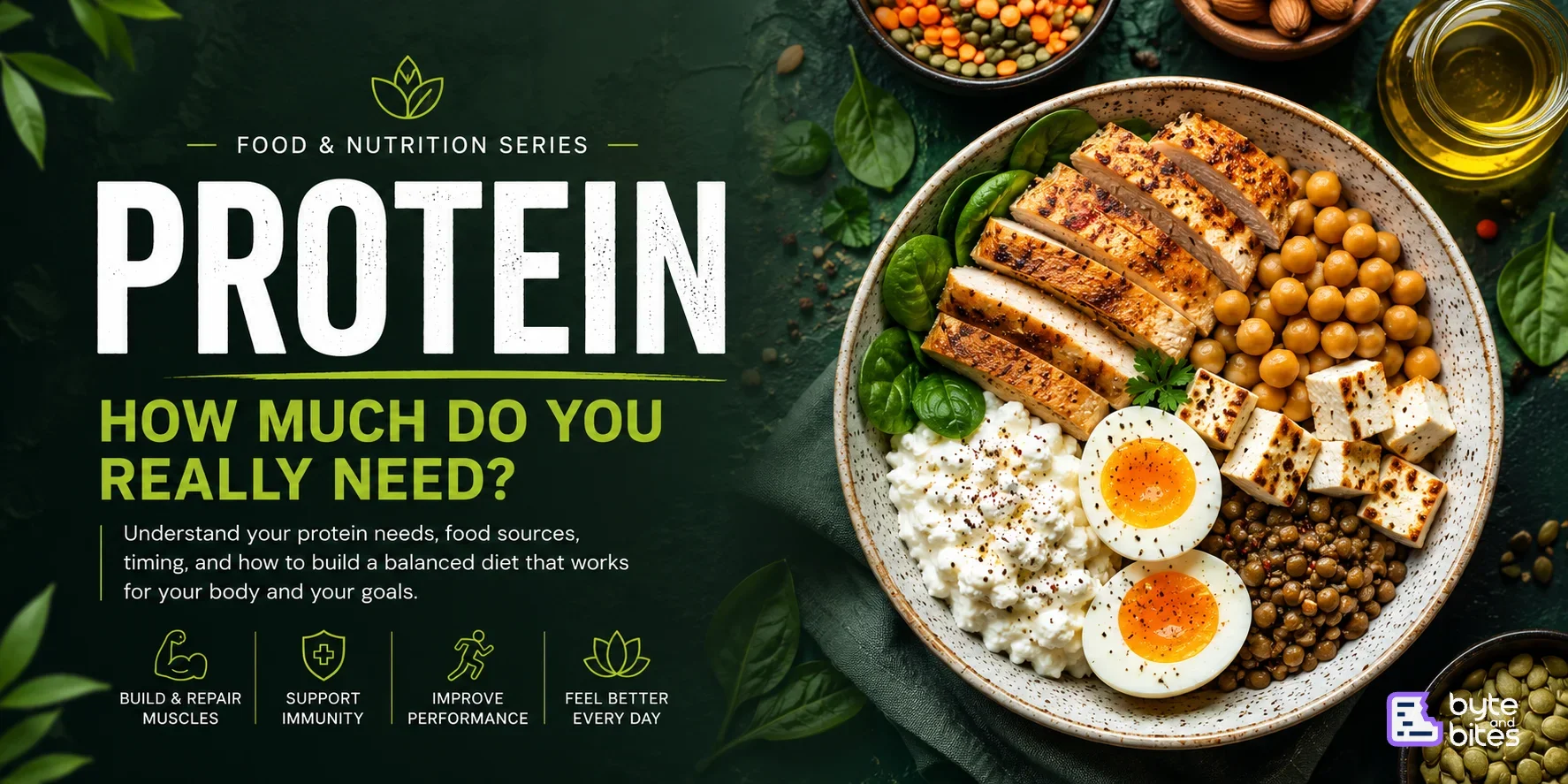
Protein is an essential part of a healthy diet, but how much do you really need? This blog explains daily protein requirements, how your needs change with activity and fitness goals, the best animal and plant-based sources, the role of protein powder, and simple ways to add more protein to everyday meals.
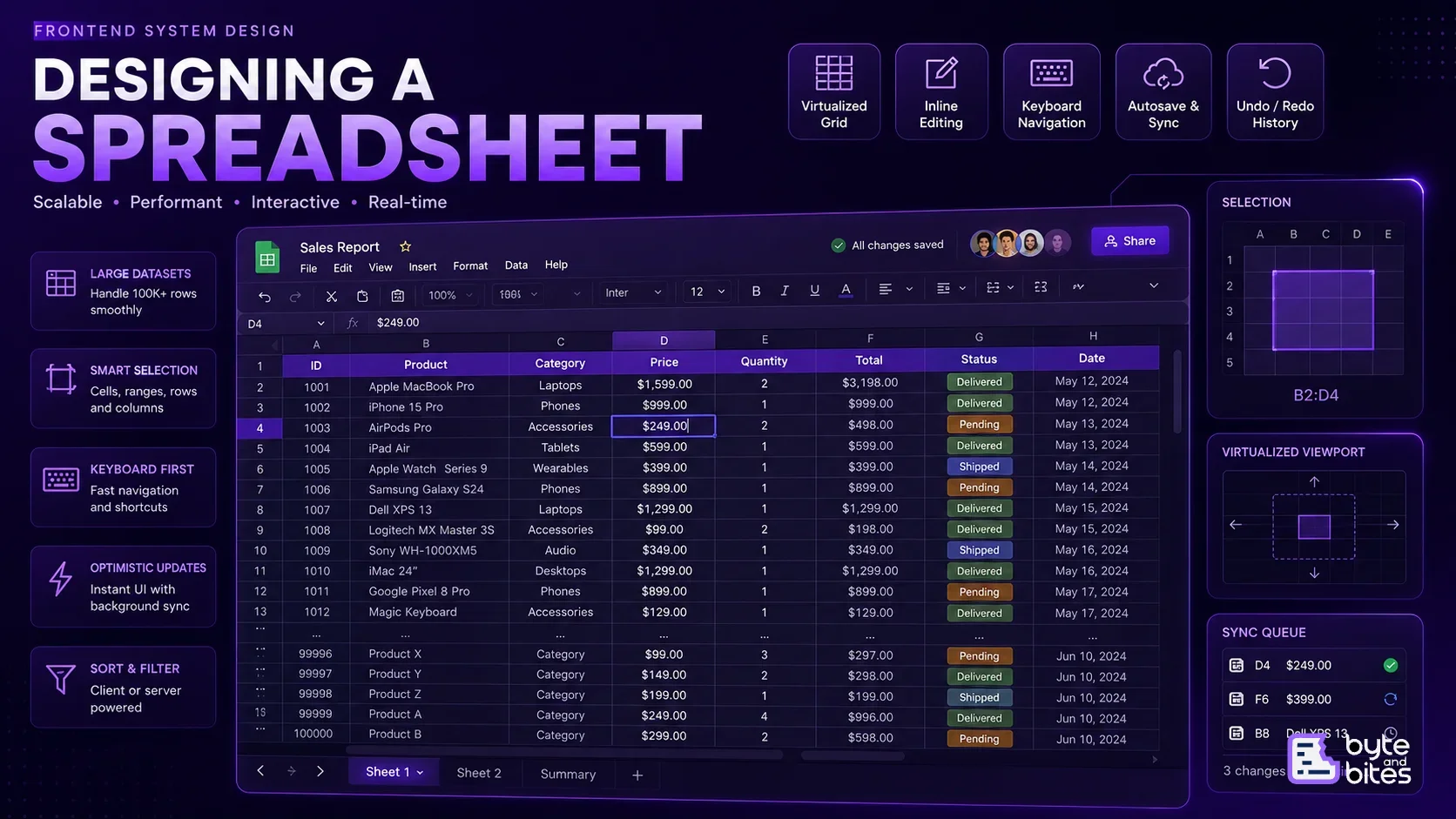
A spreadsheet looks simple on the surface: rows, columns, and editable cells. The challenge starts when the spreadsheet contains tens of thousands of rows and users expect scrolling, editing, selection, and keyboard interactions to remain instant. In this article, we'll design a spreadsheet similar to Google Sheets or Airtable, focusing on virtualization, cell state, keyboard interactions, editing, autosave, and efficient rendering.
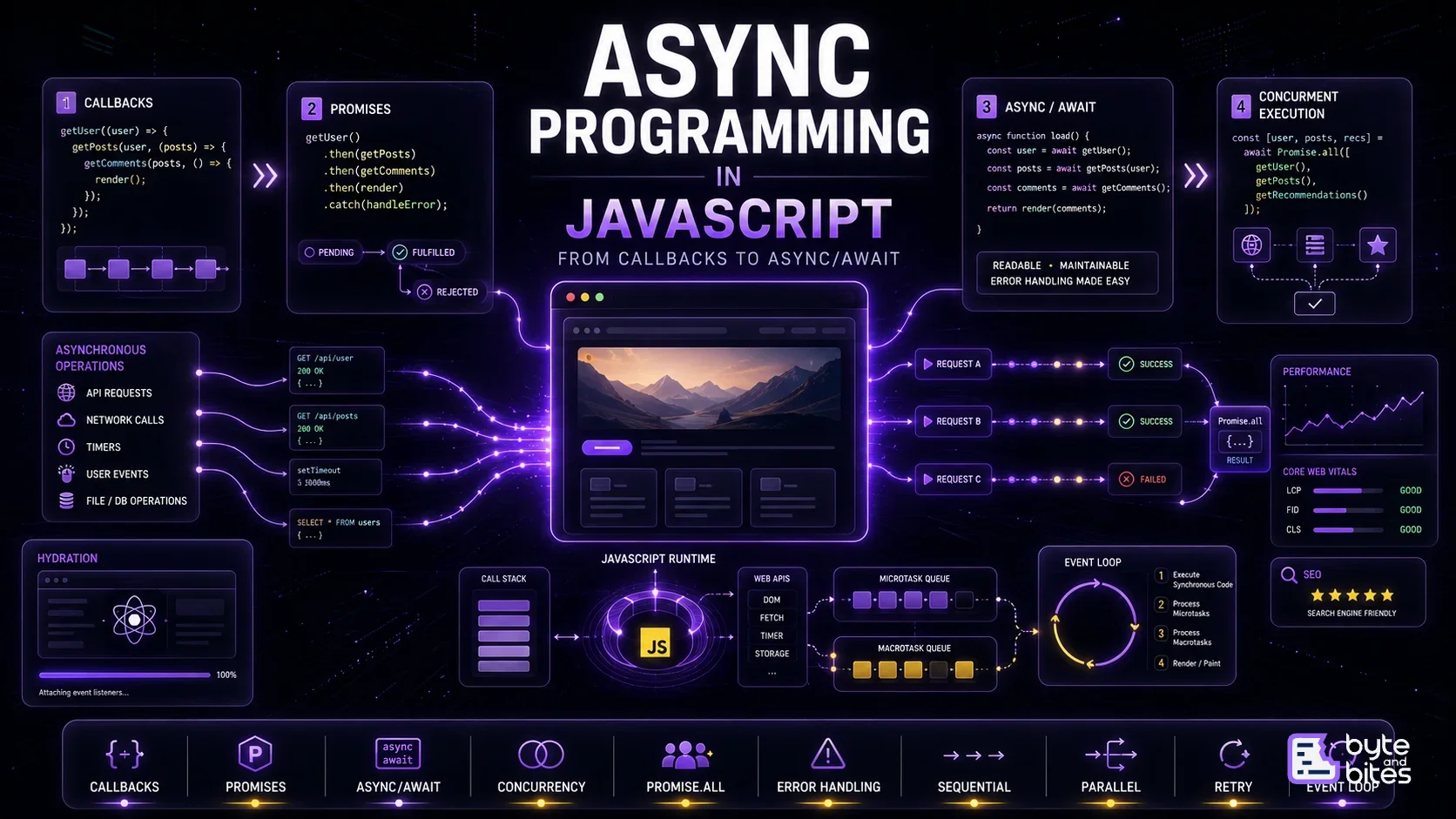
Learn asynchronous programming in JavaScript through practical examples. Understand callbacks, Promises, async/await, Promise.all, Promise.allSettled, sequential vs parallel execution, error handling, and concurrency patterns used in modern JavaScript applications.
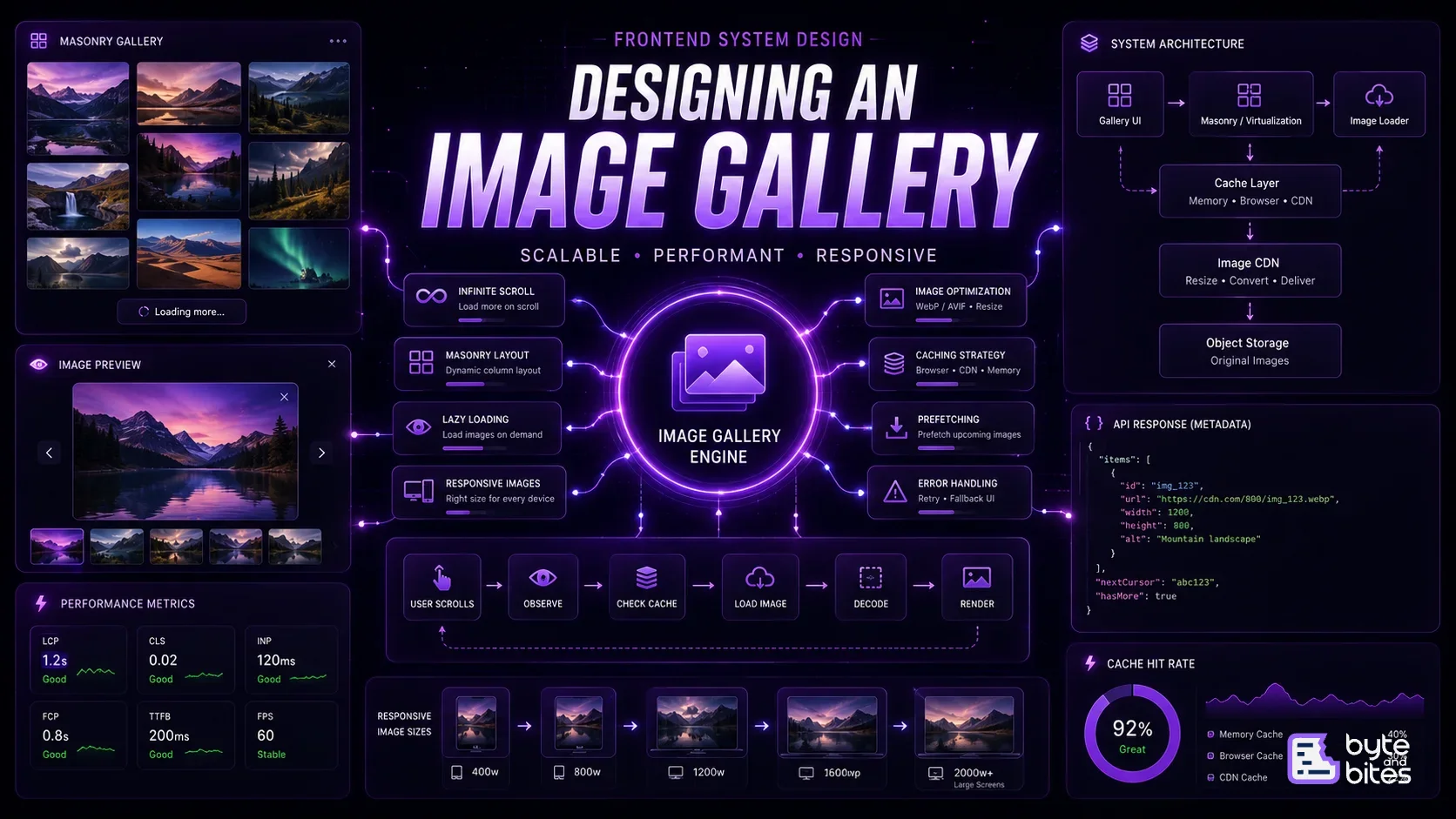
Design a scalable image gallery similar to Pinterest or Unsplash that can display thousands of images while maintaining smooth scrolling and fast loading. The system should handle responsive layouts, lazy loading, image optimization, infinite scrolling, caching, and efficient rendering. The main challenge is to ensure that the browser doesn't download or render thousands of images unnecessarily.
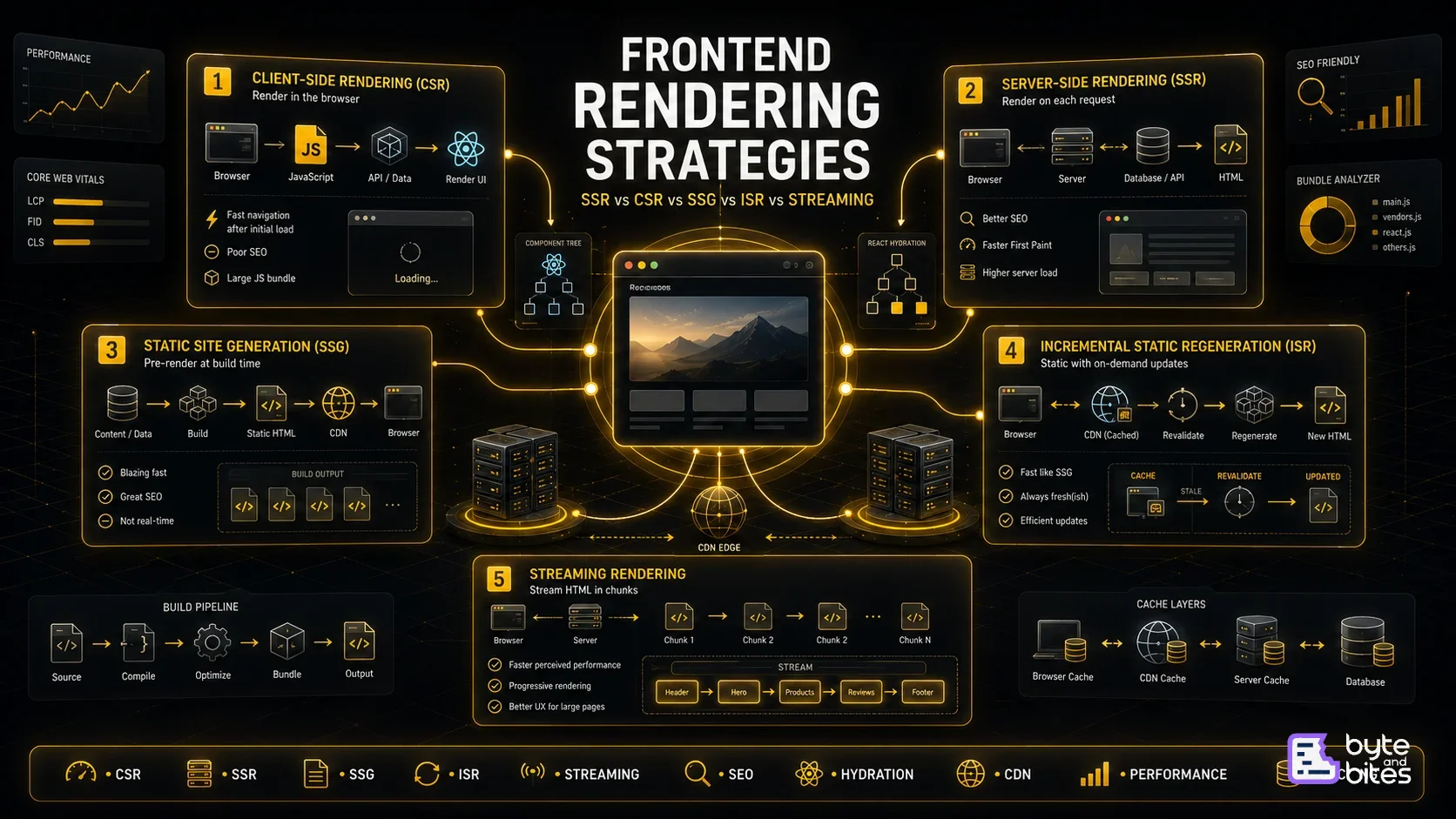
Learn the differences between CSR, SSR, SSG, ISR, and Streaming Rendering. Understand how modern frameworks like Next.js optimize SEO, performance, caching, and user experience, and discover when to use each rendering strategy in real-world frontend applications.
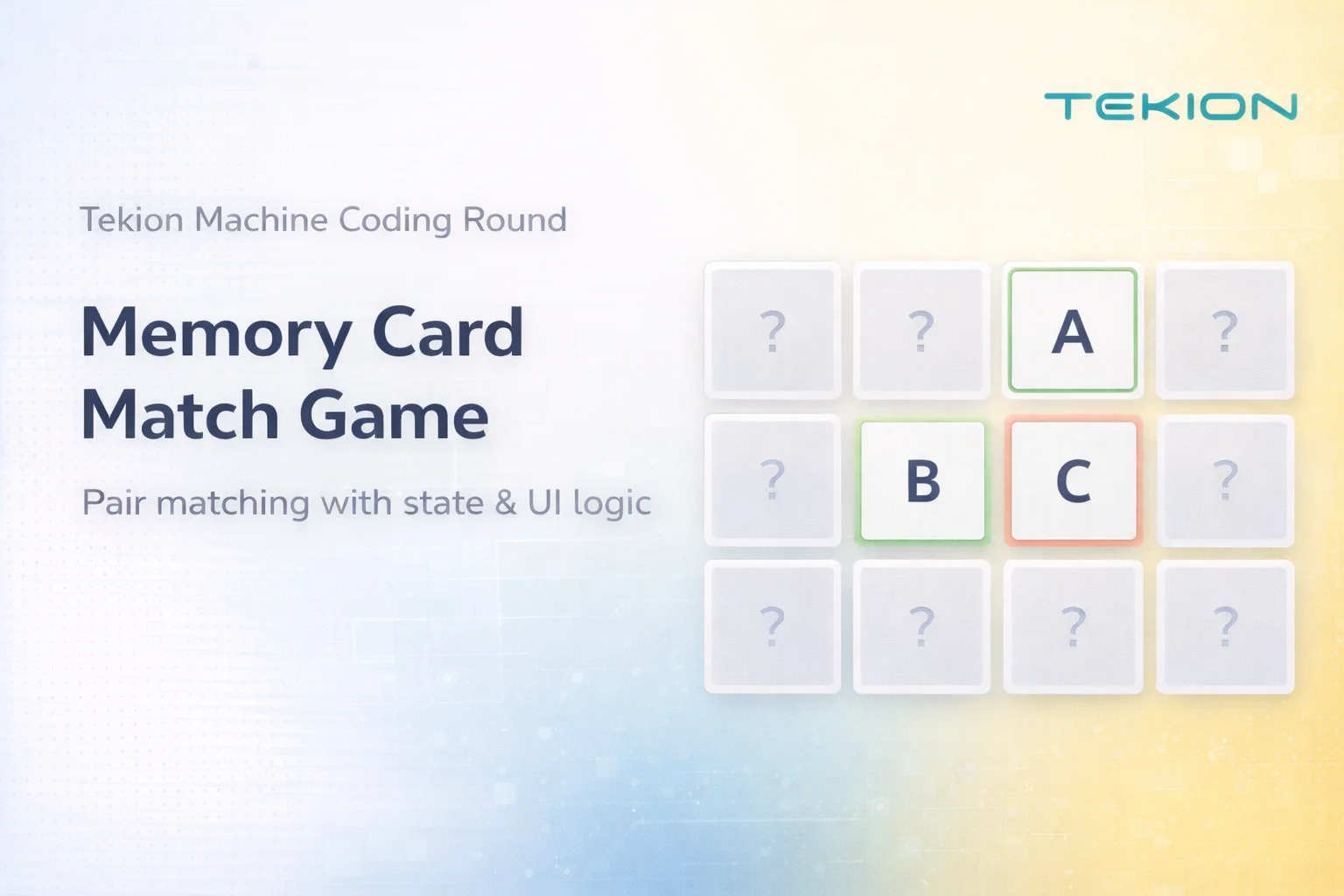
A popular machine coding problem asked in interviews at Tekion and also seen at companies like Zepto and Plum. The task is to build a card matching game using React where cards are placed face down in random order. Each card has a pair, and users reveal two cards at a time to find matches. Matching pairs stay visible, while incorrect pairs flip back after a short delay. The game ends when all pairs are matched.
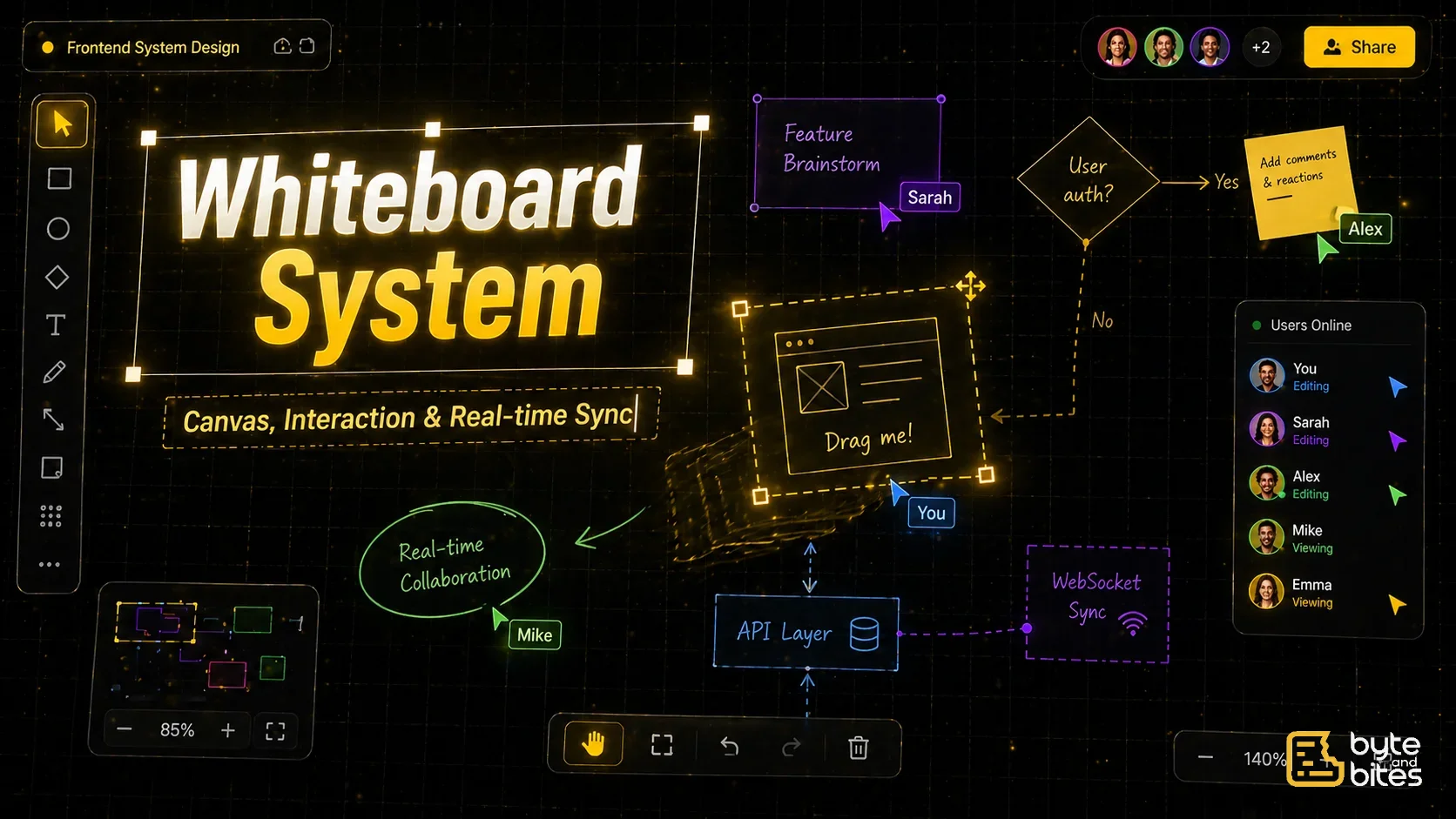
A whiteboard or Figma-like system allows users to create, edit, and collaborate on visual elements over an infinite canvas. It combines complex UI interactions like drag, resize, zoom, and selection with real-time synchronization. This problem tests your ability to design scalable UI systems, manage spatial data, and handle collaborative state efficiently.
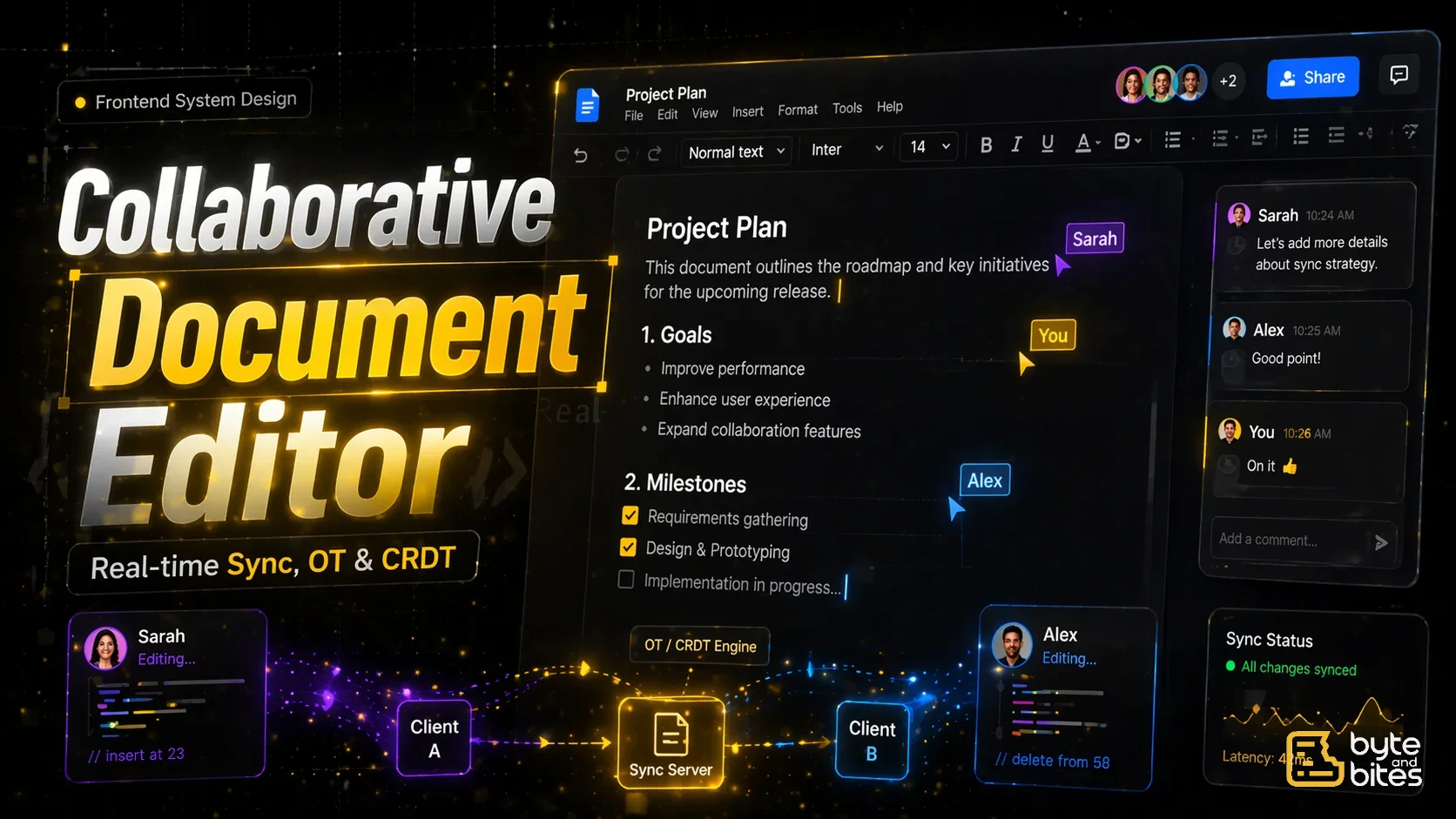
A collaborative document editor allows multiple users to edit the same document in real time. Systems like Google Docs handle concurrent edits, maintain consistency, and provide a seamless editing experience. This problem tests your understanding of real-time synchronization, conflict resolution, and scalable frontend architecture.
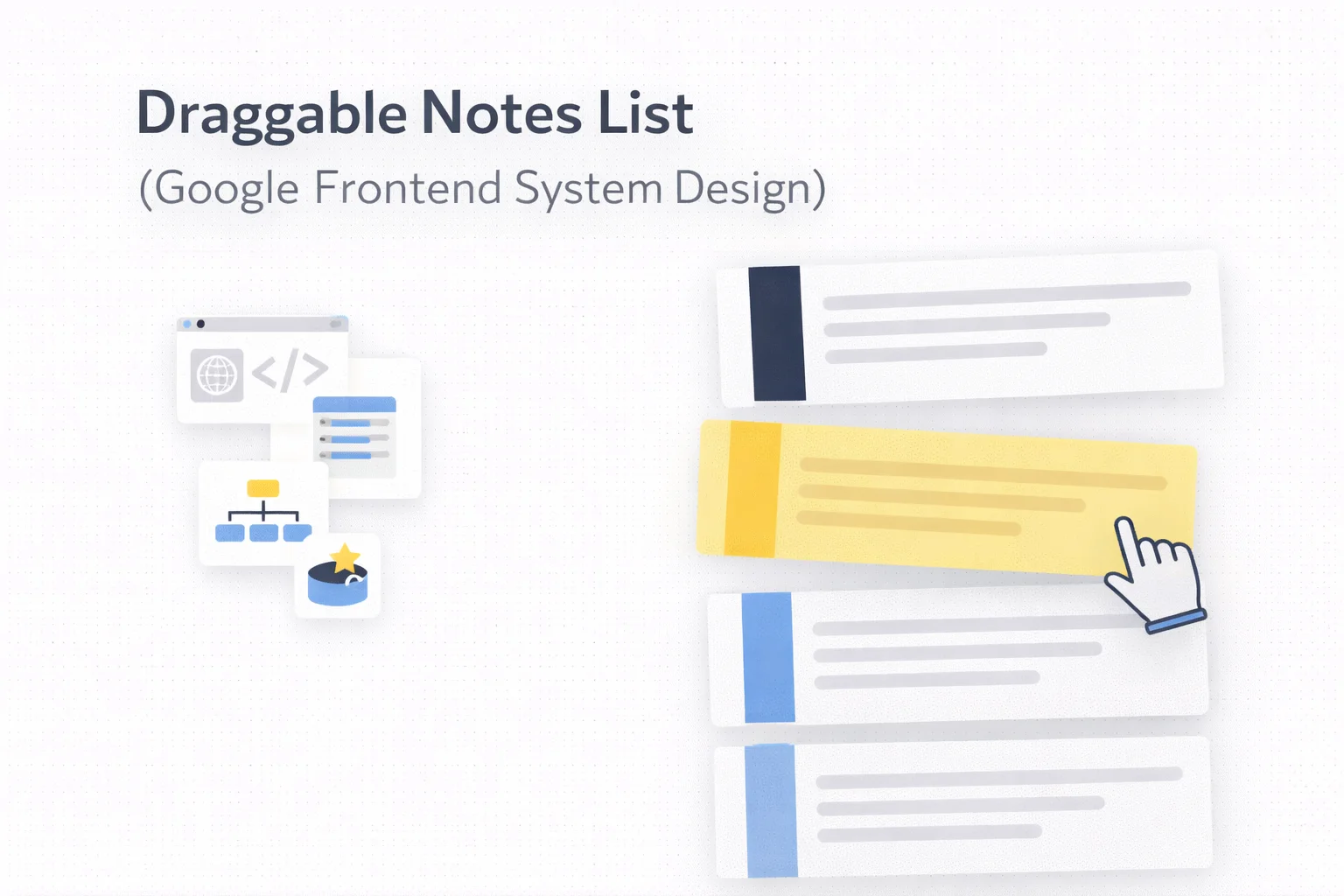
A common frontend system design question asked at Google focuses on building a draggable list of notes. Users should be able to reorder items via drag-and-drop and have the updated order persist across sessions. This tests your understanding of DOM interactions, state management, event handling, and client-side persistence in real-world UI systems.

Performance is one of the most important aspects of frontend engineering. Users expect applications to load instantly, respond immediately, and feel smooth regardless of their device or network conditions. Building a performant application is not about a single optimization. It requires thoughtful architecture across networking, rendering, caching, asset delivery, JavaScript execution, and user interactions. In this article, we'll design a high-performance frontend architecture and explore where optimizations should be applied throughout the lifecycle of a web application.
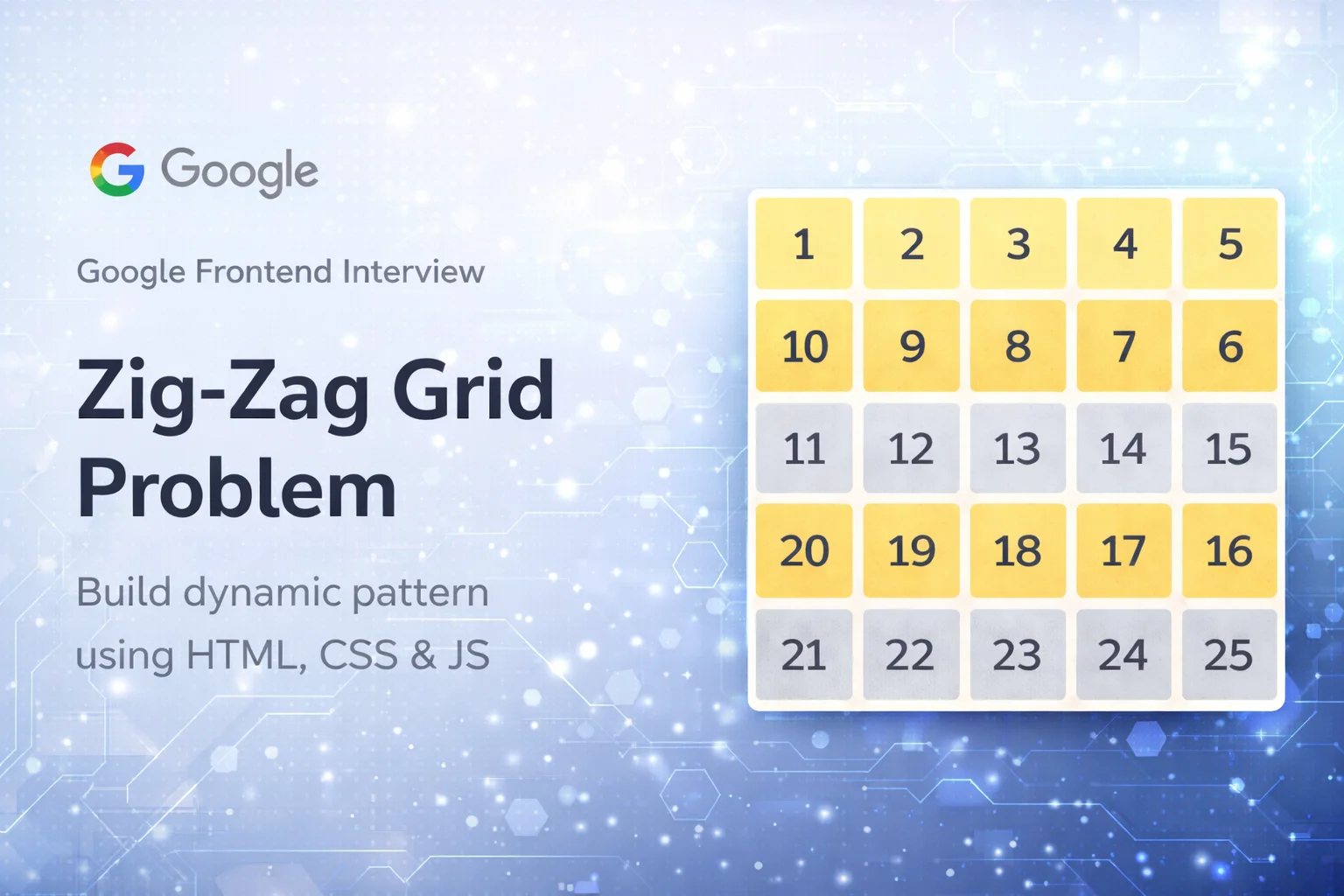
A classic platform-round problem asked at Google where you build a dynamic zig-zag numbered grid using HTML, CSS, and JavaScript. Given an input n, generate an n × n grid where numbers alternate direction in each row. This tests DOM manipulation, logical thinking, and clean UI rendering under real interview constraints.
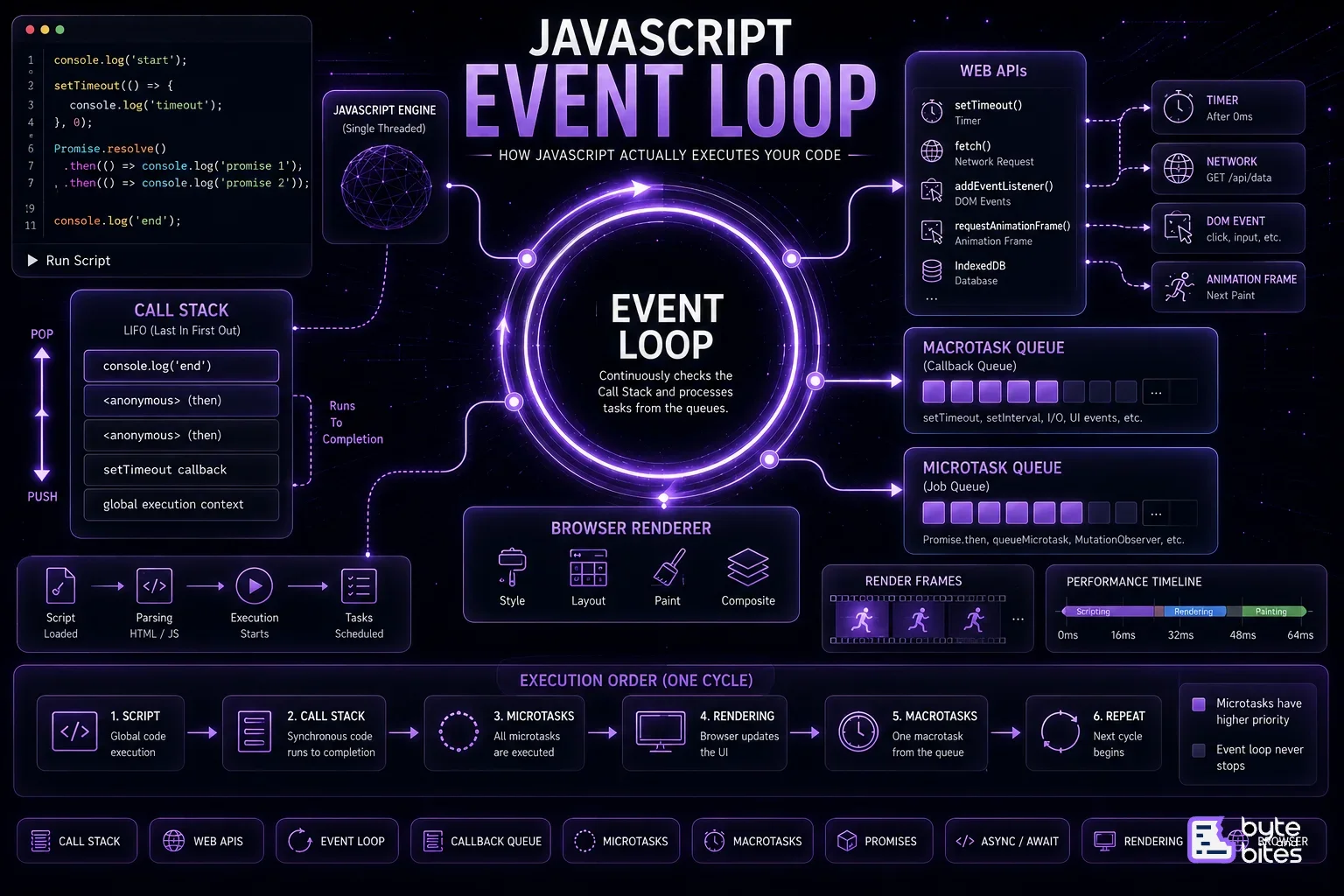
Learn how the JavaScript Event Loop works through visual explanations of the Call Stack, Web APIs, Callback Queue, Microtask Queue, Macrotasks, Promises, async/await, and rendering. Understand how browsers execute asynchronous JavaScript and why code runs in the order it does.
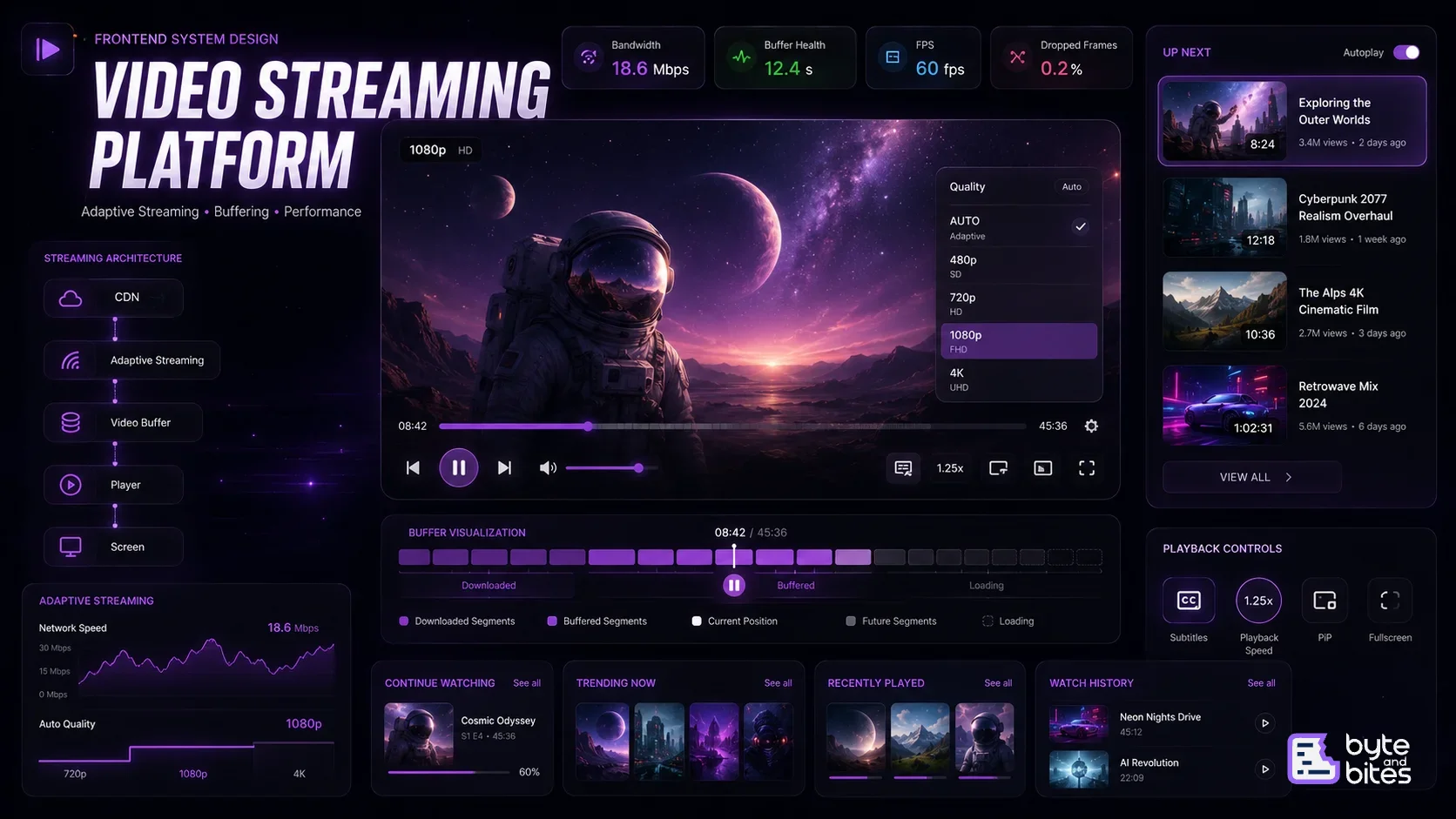
Modern video streaming platforms like YouTube, Netflix, and Prime Video deliver a seamless viewing experience despite varying network conditions and large media files. A frontend video player must efficiently handle adaptive streaming, buffering, caching, playback controls, subtitles, quality switching, and playlist management while maintaining smooth performance across devices. This problem tests your understanding of media APIs, browser rendering, networking, performance optimization, and frontend architecture.
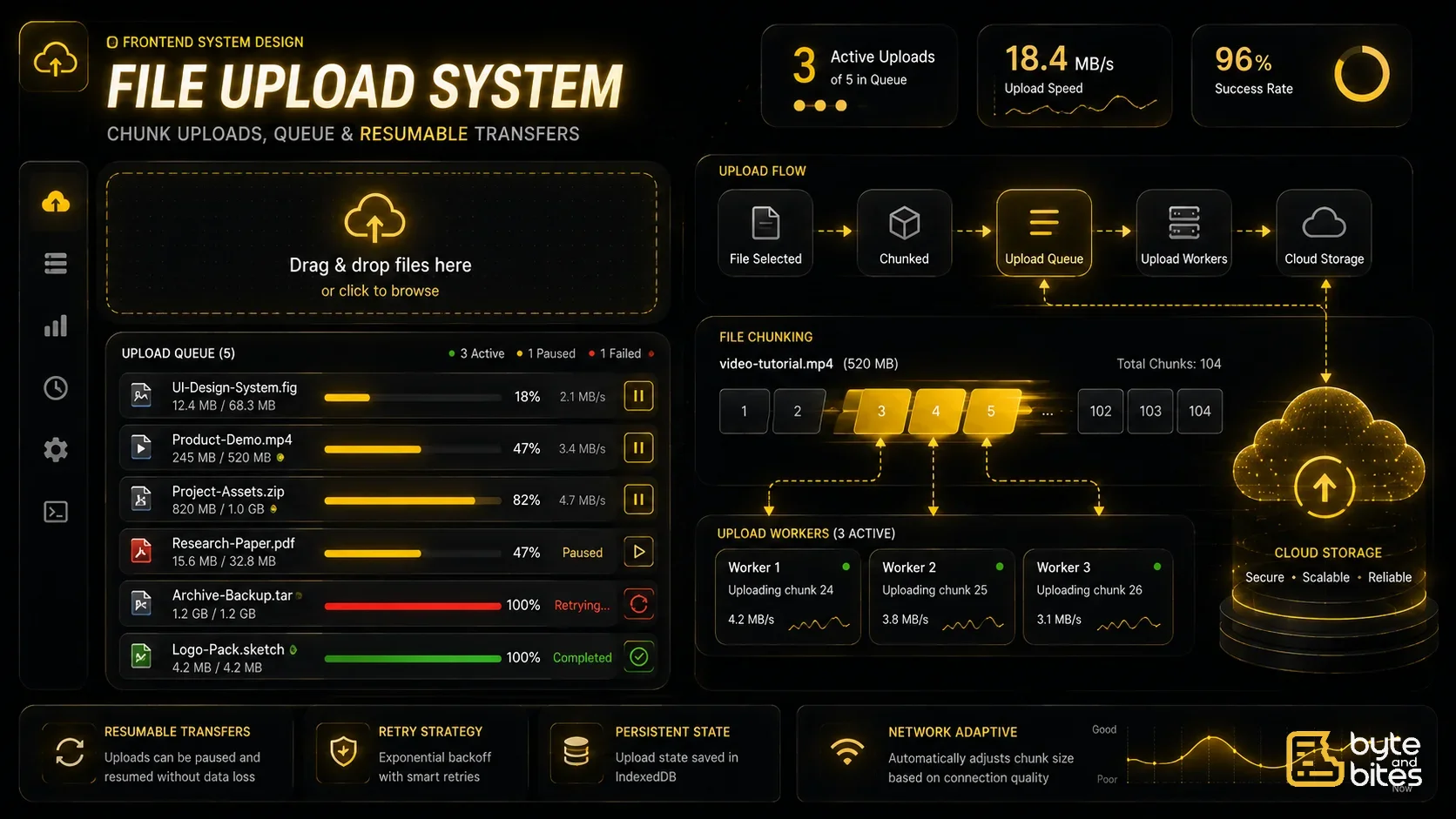
File uploads appear simple on the surface, but building a production-ready upload system involves much more than selecting a file and sending it to a server. A robust uploader must handle large files, network failures, retries, progress tracking, pause/resume, concurrent uploads, and efficient resource management while providing a smooth user experience. This problem tests your understanding of asynchronous workflows, browser APIs, networking, state management, and scalable frontend architecture.
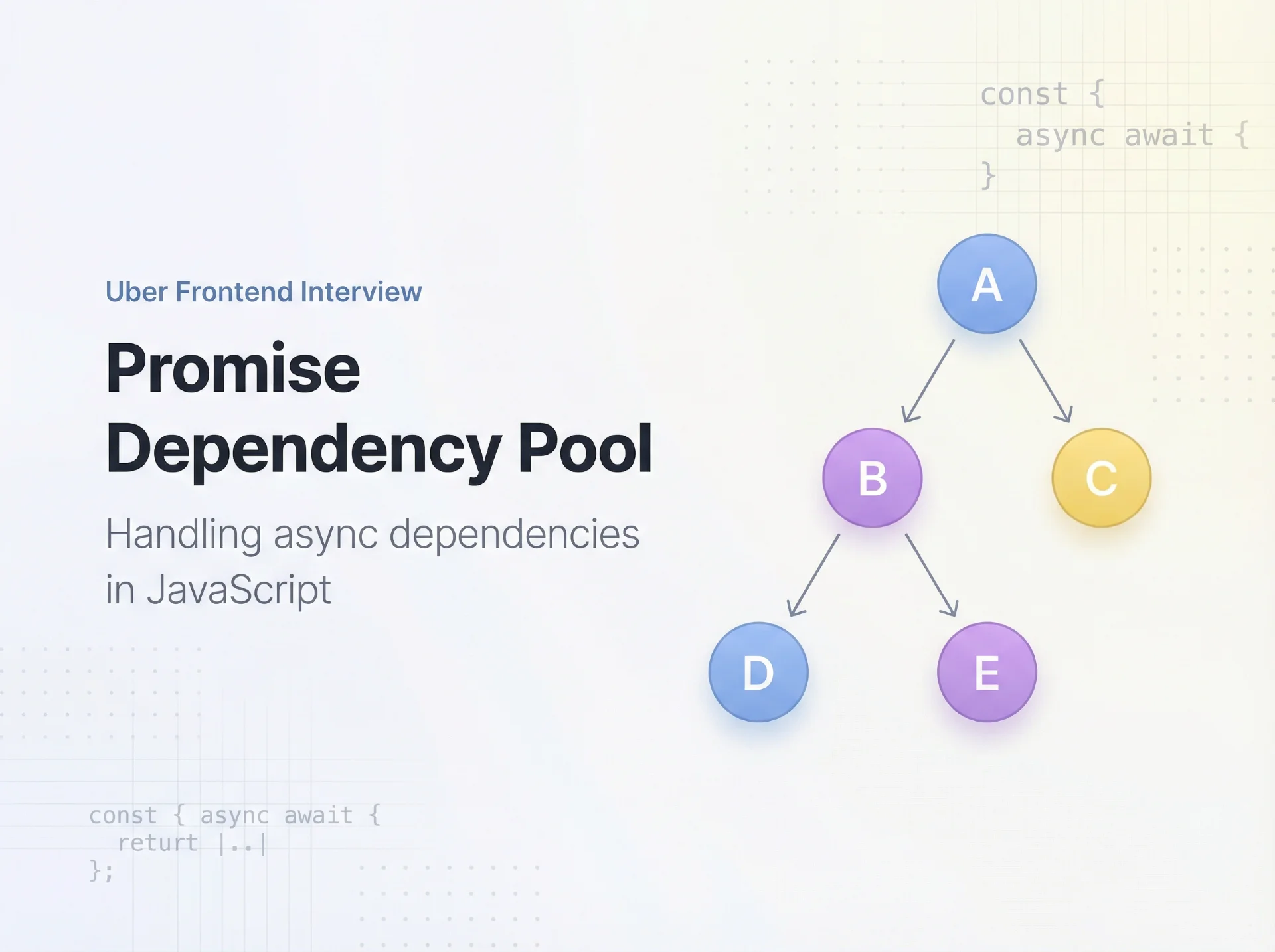
A real-world async control problem inspired by Uber interviews. Given multiple promises with dependencies (e.g., A depends on B & C, B depends on D & E), design a system to execute them in the correct order. This tests your understanding of JavaScript promises, dependency graphs, concurrency control, and writing clean, scalable async orchestration logic.
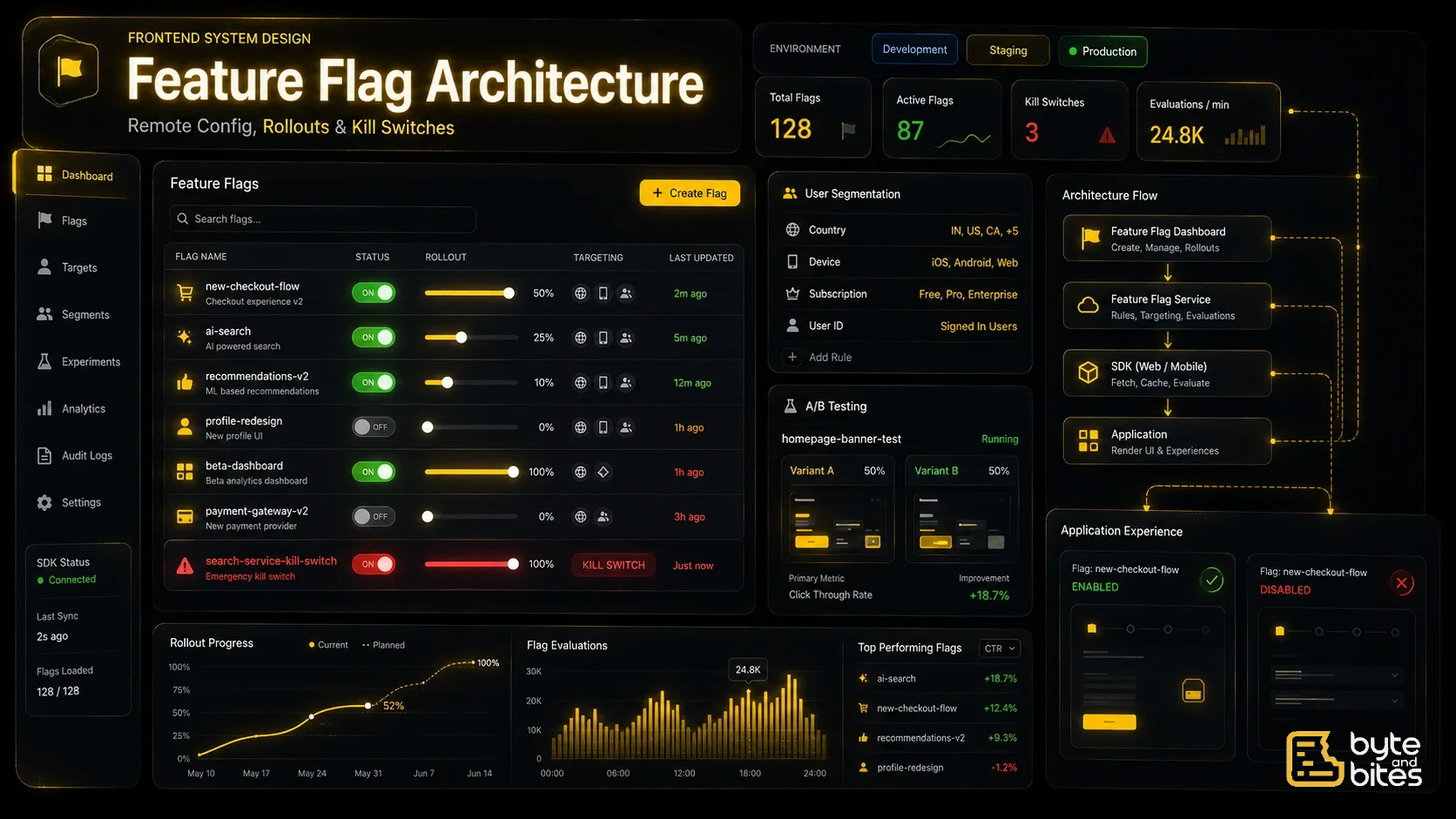
Feature flags (also called feature toggles) allow developers to enable or disable features without deploying new code. Modern applications use feature flags for gradual rollouts, A/B testing, canary releases, emergency kill switches, and user segmentation. A well-designed frontend feature flag system enables rapid experimentation while keeping applications performant, scalable, and resilient.
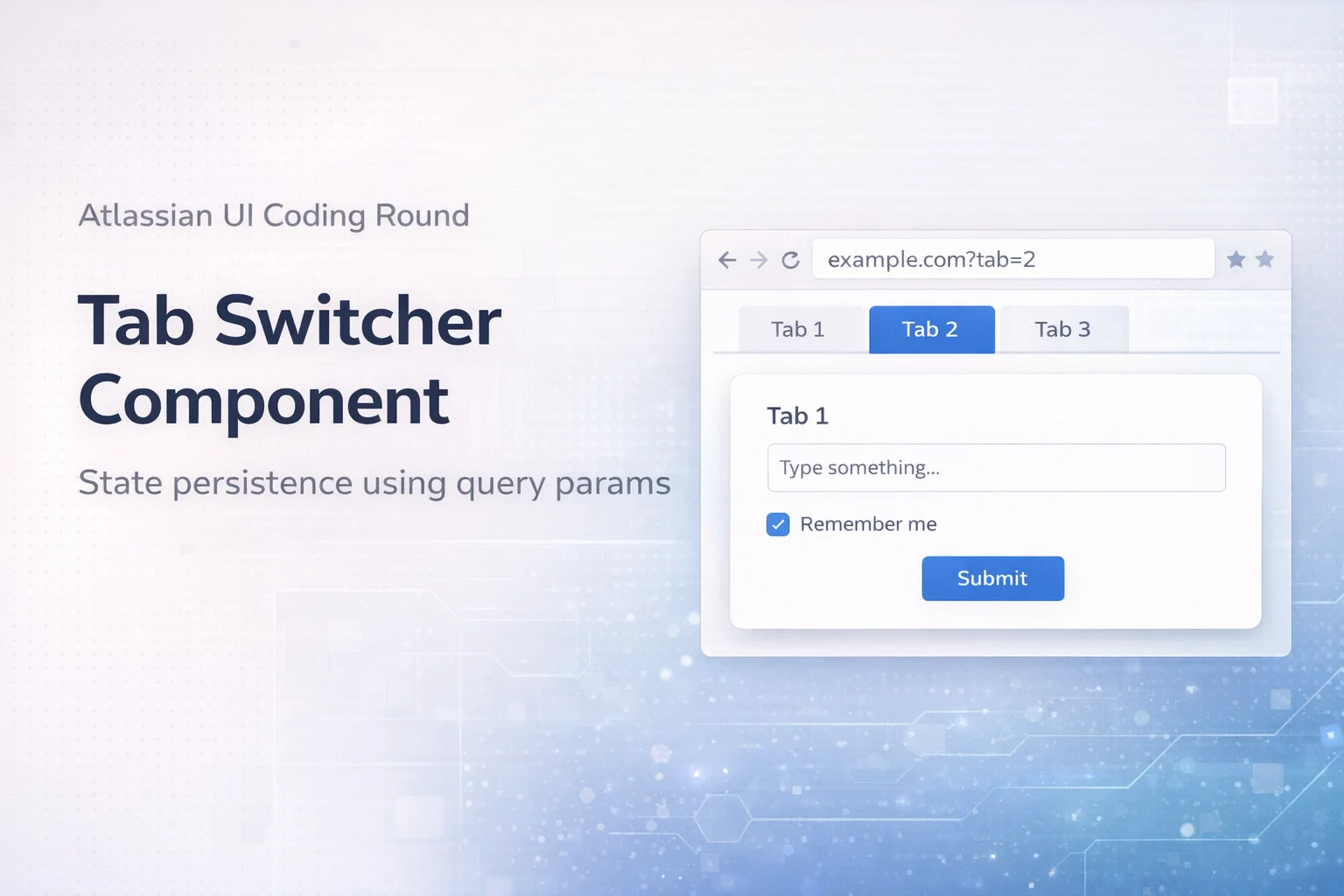
A practical UI coding problem asked in interviews at Atlassian focuses on building a tab switcher component. Users can switch between multiple tabs, each displaying different content. As a follow-up, the selected tab should persist using query parameters so the same state is restored on refresh or when sharing the URL.
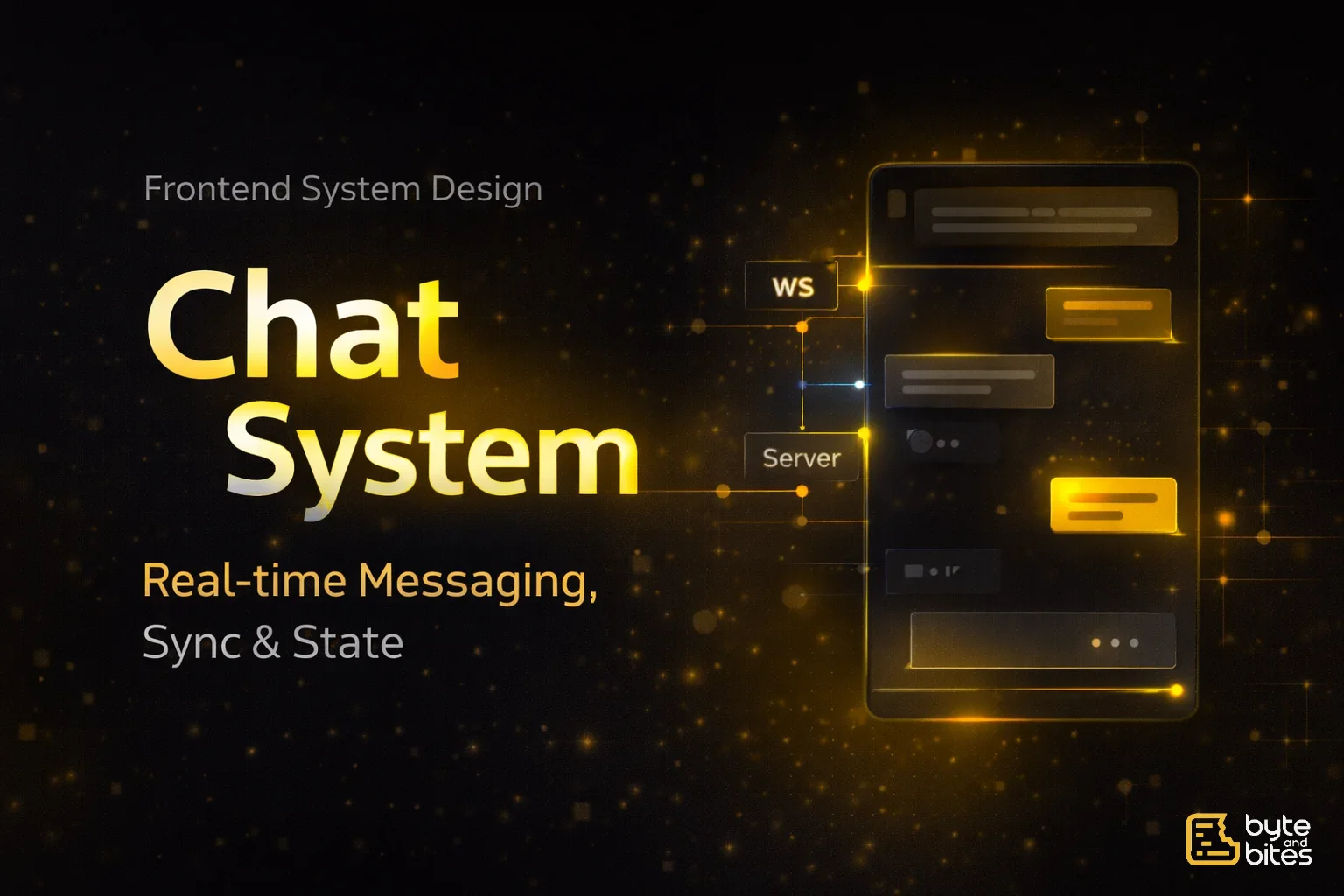
Chat systems are one of the most common real-time frontend challenges, used in messaging apps, support systems, and collaborative tools. The goal is to build a responsive UI that can send, receive, and display messages in real time while handling network delays, ordering, and state consistency. This problem tests your understanding of real-time data flow, optimistic updates, and UI synchronization.
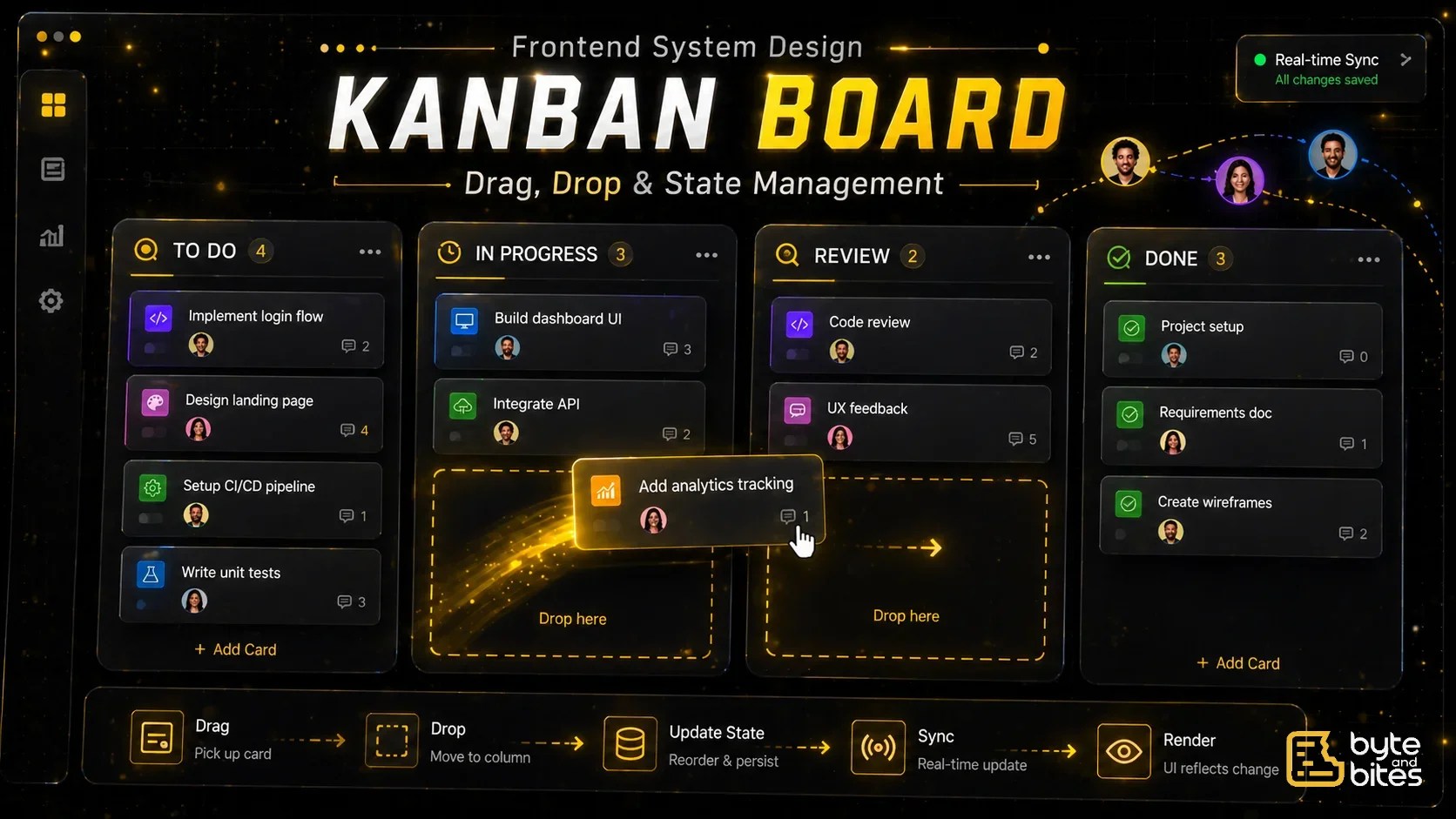
A Kanban board is a task management system where items are organized into columns and can be moved across stages using drag and drop. Tools like Jira use this model extensively. This problem tests your ability to handle complex UI interactions, state management, and efficient updates while maintaining a smooth user experience.

A commonly asked frontend problem in interviews at Fleek, Atlassian, and Zepto focuses on building a nested folder/file structure similar to an IDE. The task involves designing a data structure to represent folders and files, and rendering it recursively in JavaScript. It tests your understanding of tree structures, recursion, and UI state handling.
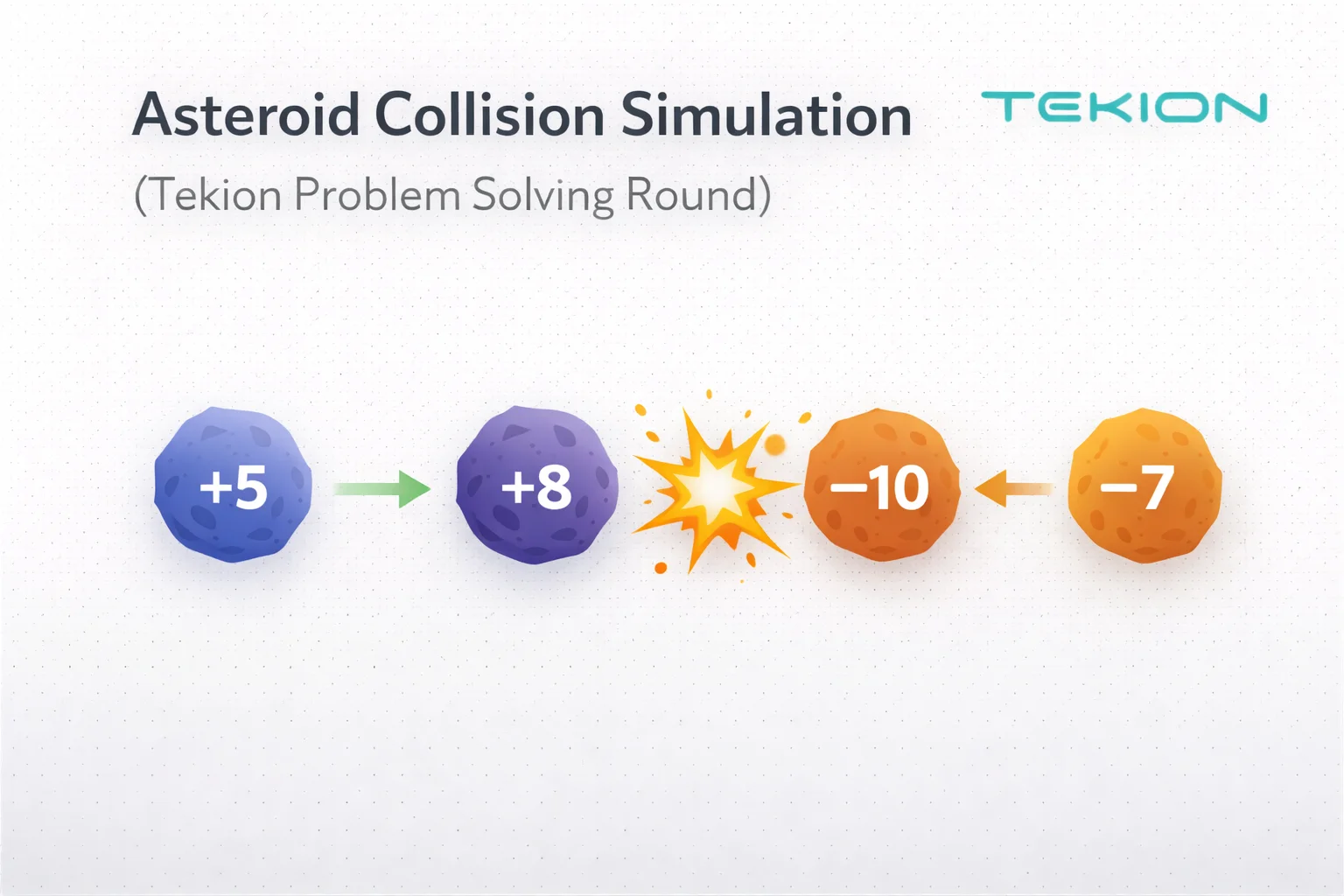
A classic stack-based problem asked in interviews at Tekion. You are given an array of integers where each value represents an asteroid’s direction and weight—positive moves left to right, negative moves right to left. When two asteroids collide, the heavier one survives. The goal is to determine which asteroids remain after all collisions are resolved.

Calendar systems are complex UI applications used for scheduling, planning, and collaboration. Building something like Google Calendar involves handling time-based data, interactive UI (drag, resize), and synchronization with backend events. This problem tests your ability to manage complex state, design scalable UI components, and handle user interactions efficiently.
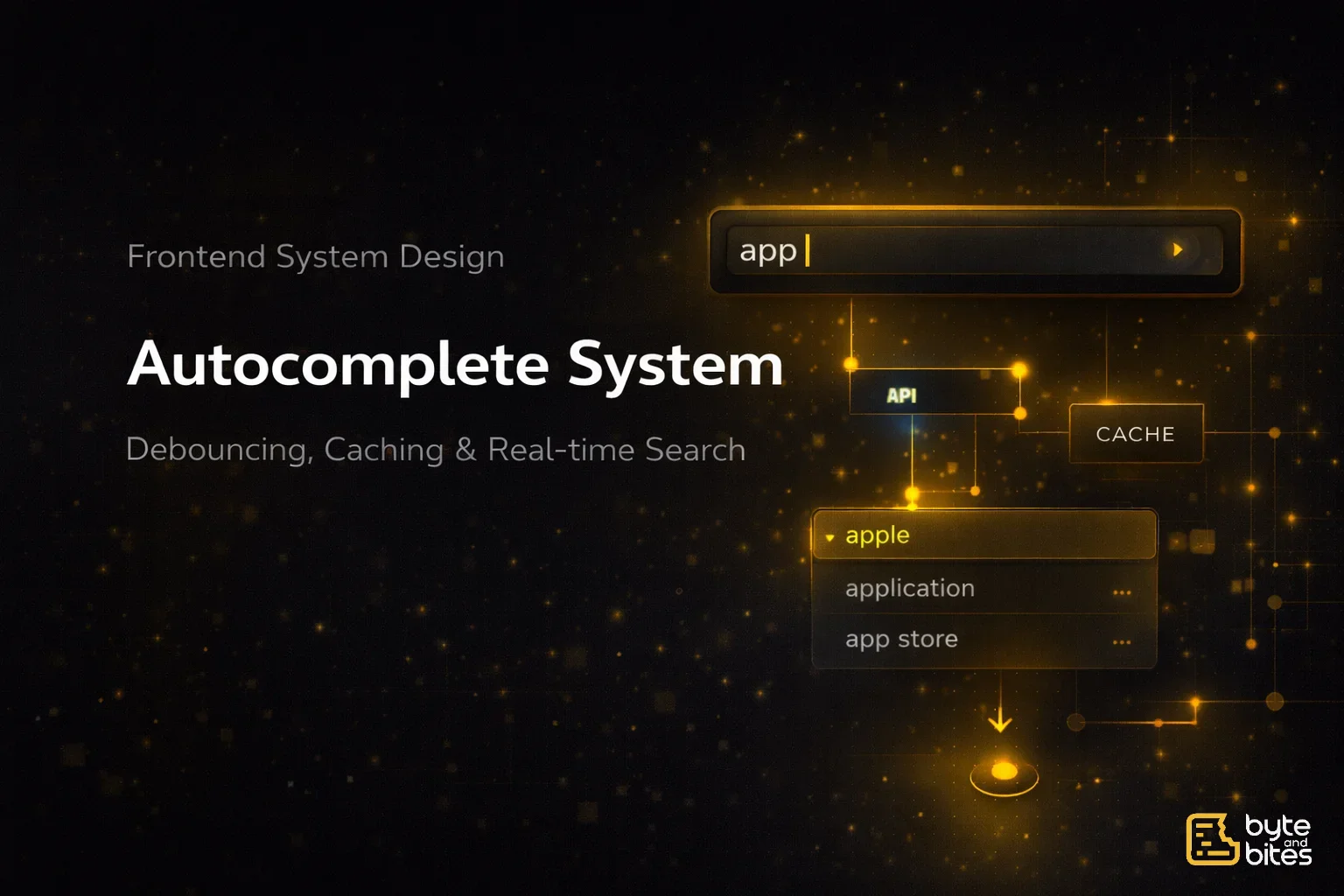
Autocomplete is a widely used UI pattern seen in search bars, mentions, and suggestions across products. The goal is to fetch and display relevant suggestions as the user types, while ensuring performance, responsiveness, and correctness. This problem tests how you handle user input, API interaction, caching, and race conditions in real-time systems.
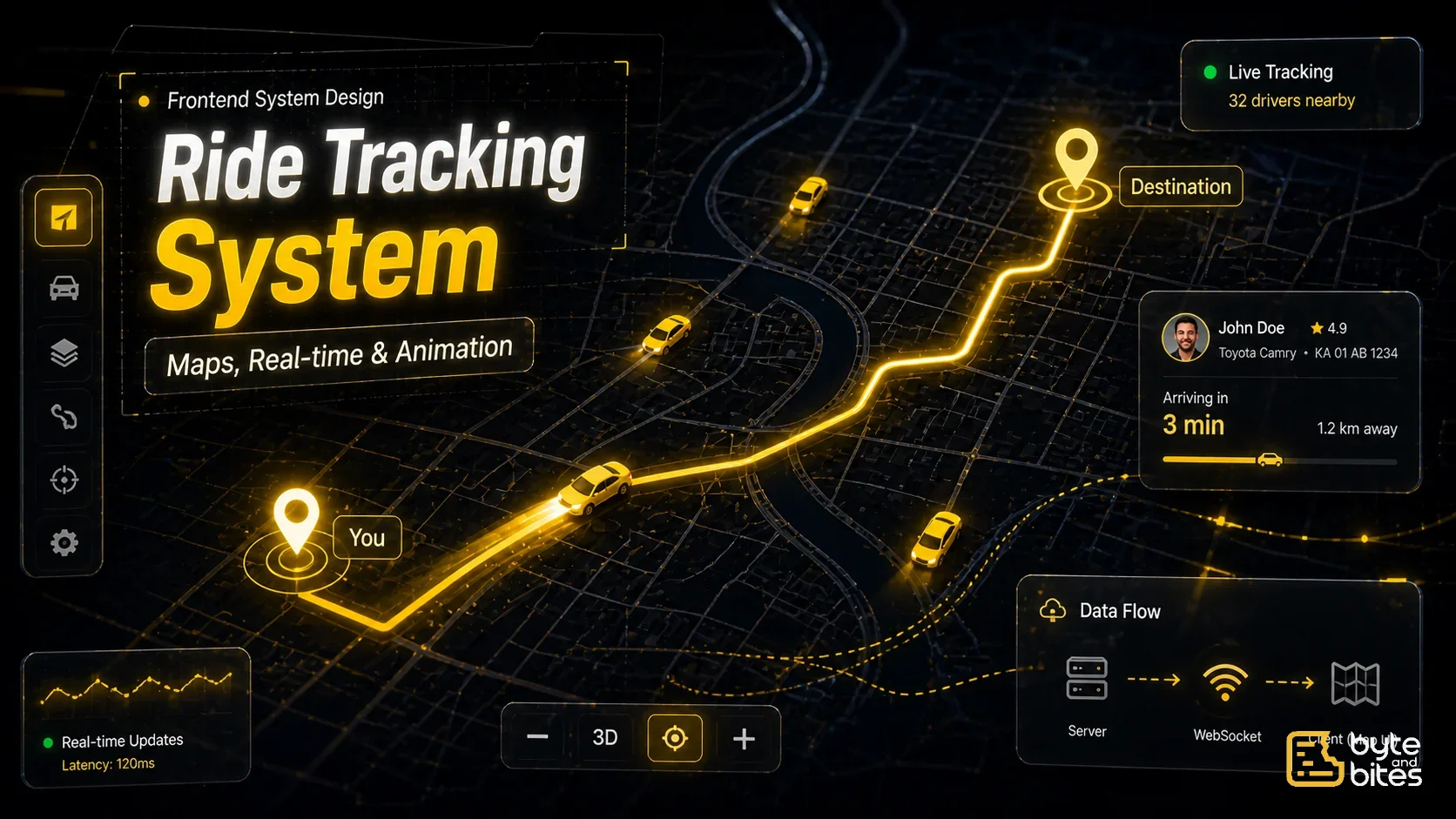
Ride tracking systems display real-time locations of drivers and routes on a map. Applications like Uber rely heavily on frontend systems to efficiently render moving vehicles, update positions smoothly, and provide an interactive map experience. This problem tests your ability to handle real-time data, optimize rendering, and manage geospatial UI efficiently.
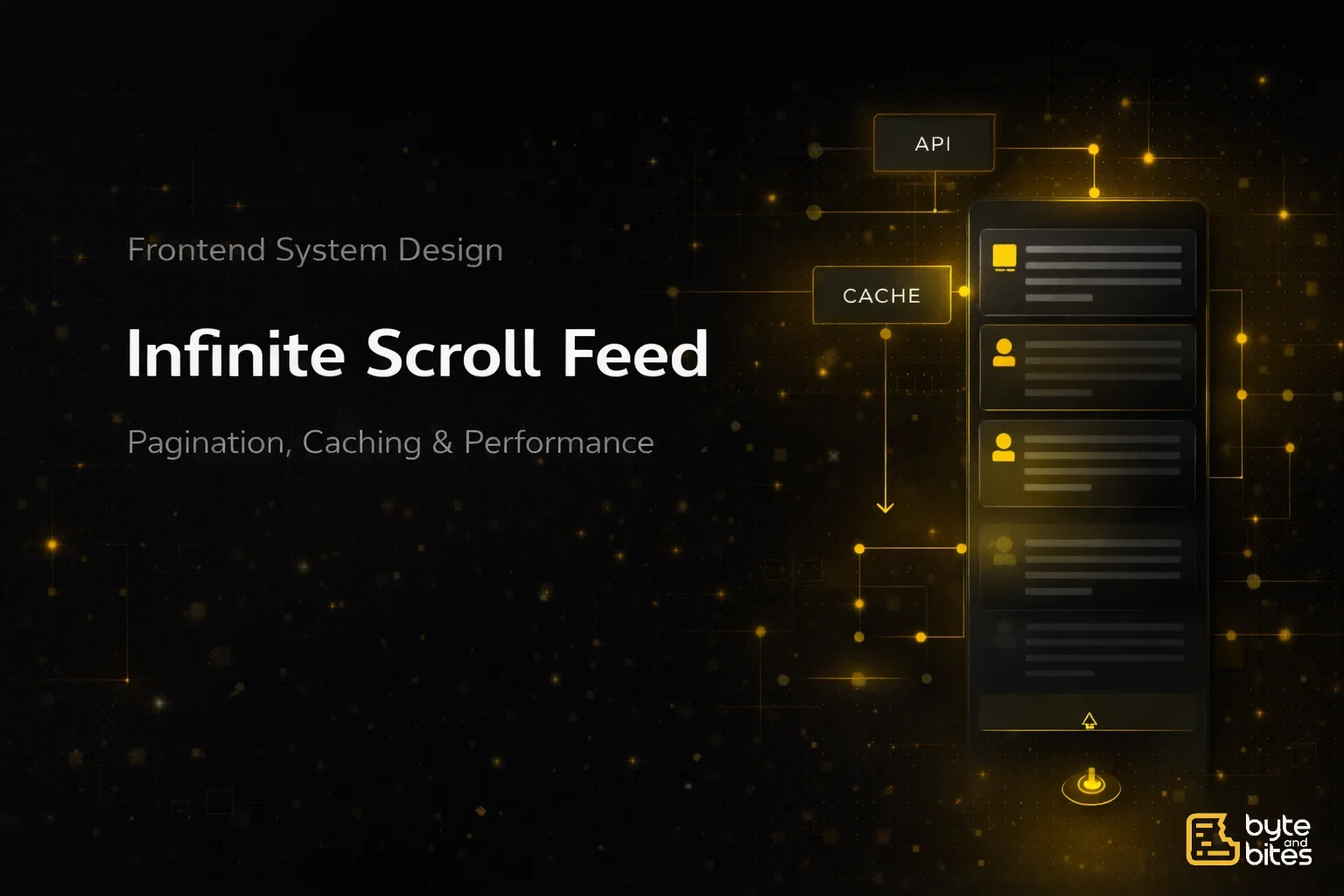
Infinite scroll is one of the most common frontend system design problems asked in interviews and used in real products like feeds, search results, and marketplaces. The goal is to load data progressively as the user scrolls, while maintaining performance, responsiveness, and a smooth user experience. This problem tests how you think about data fetching, rendering, caching, and handling edge cases at scale.
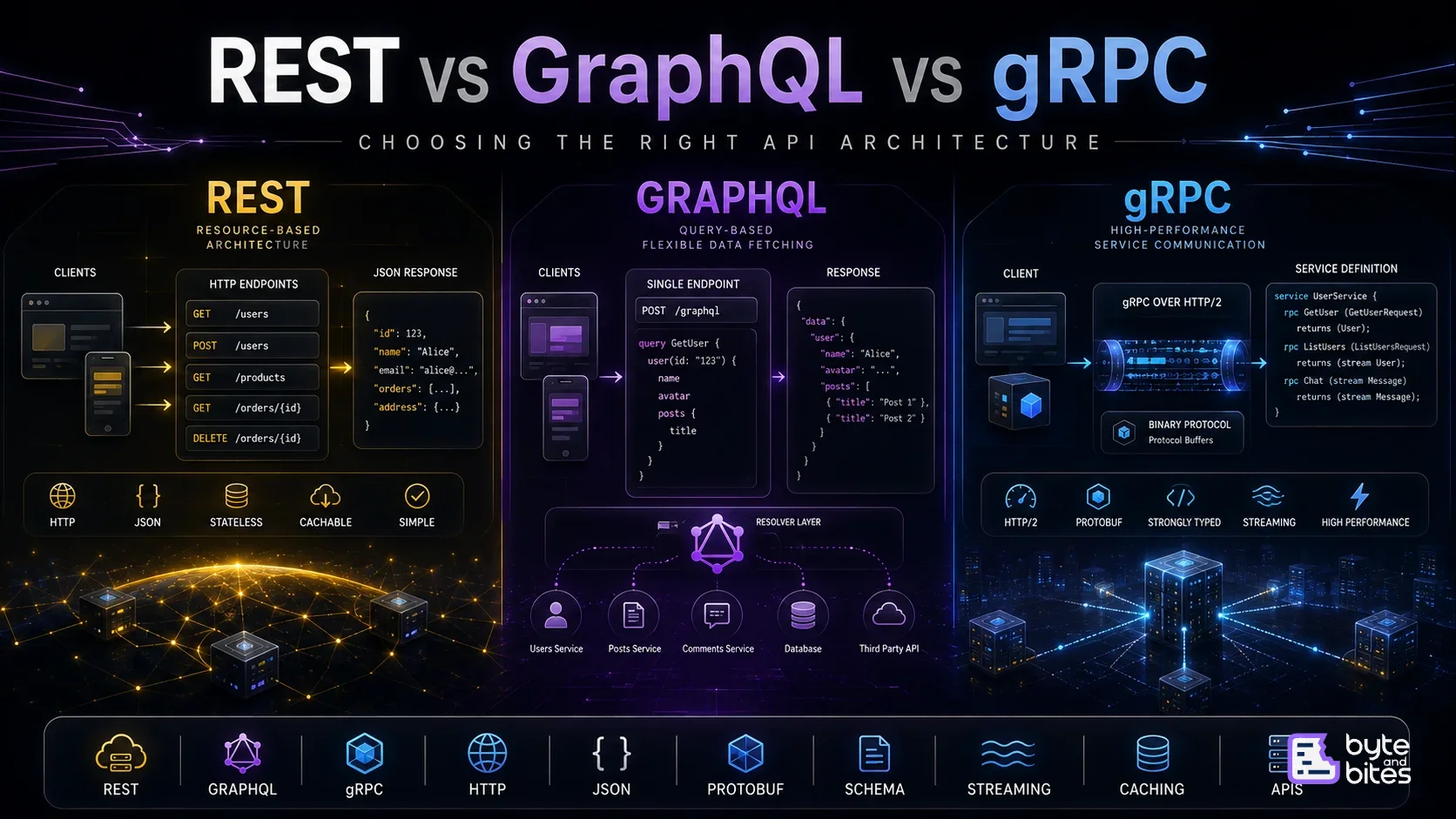
Understand the differences between REST, GraphQL, and gRPC. Learn how each API architecture handles communication, data fetching, performance, schemas, streaming, caching, and service-to-service communication, with practical examples and architecture diagrams to help you choose the right approach.
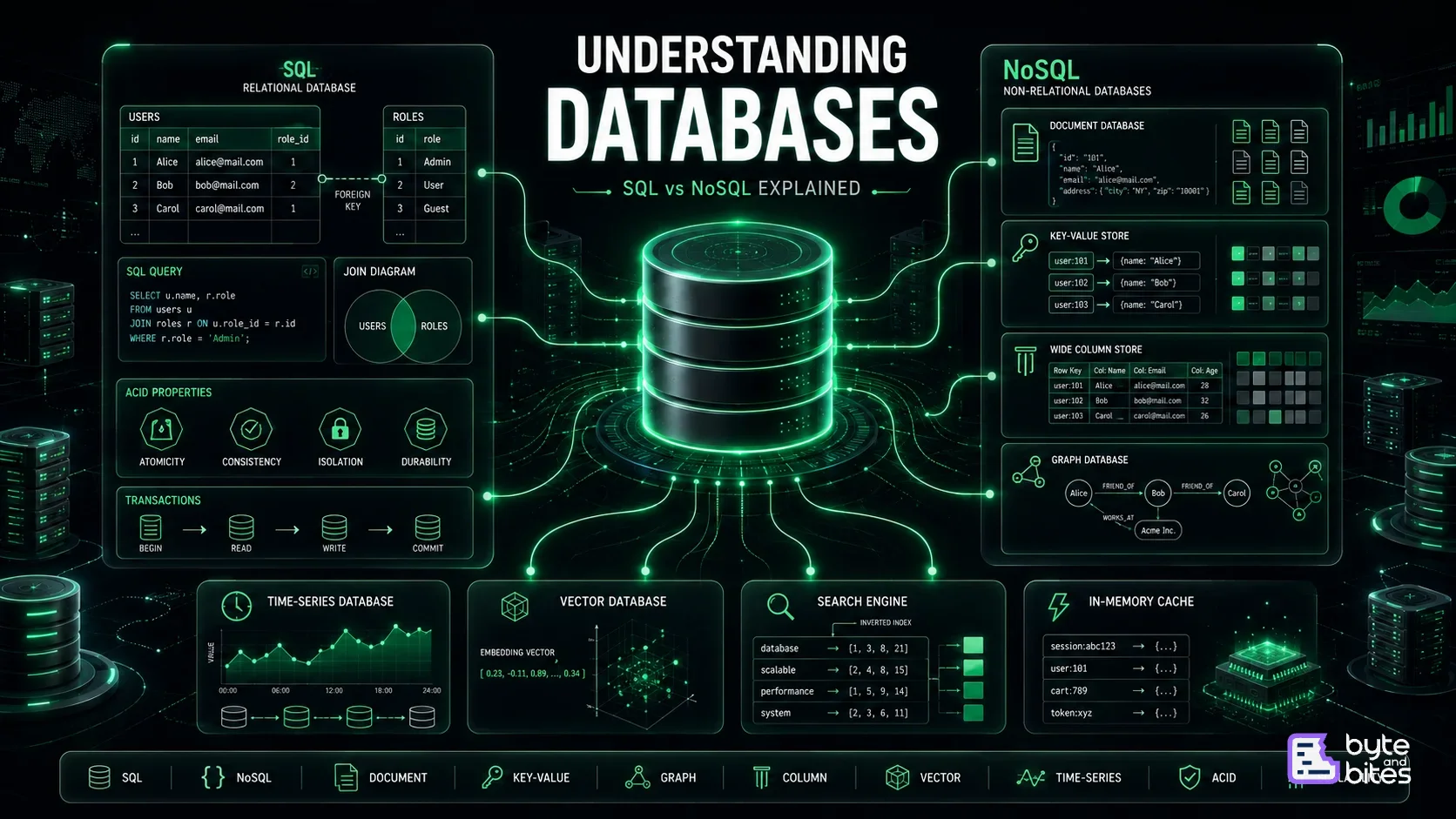
Learn the differences between SQL and NoSQL databases with practical examples. Understand relational, document, key-value, column-family, graph, time-series, and vector databases, their tradeoffs, and how to choose the right database for scalable modern applications.
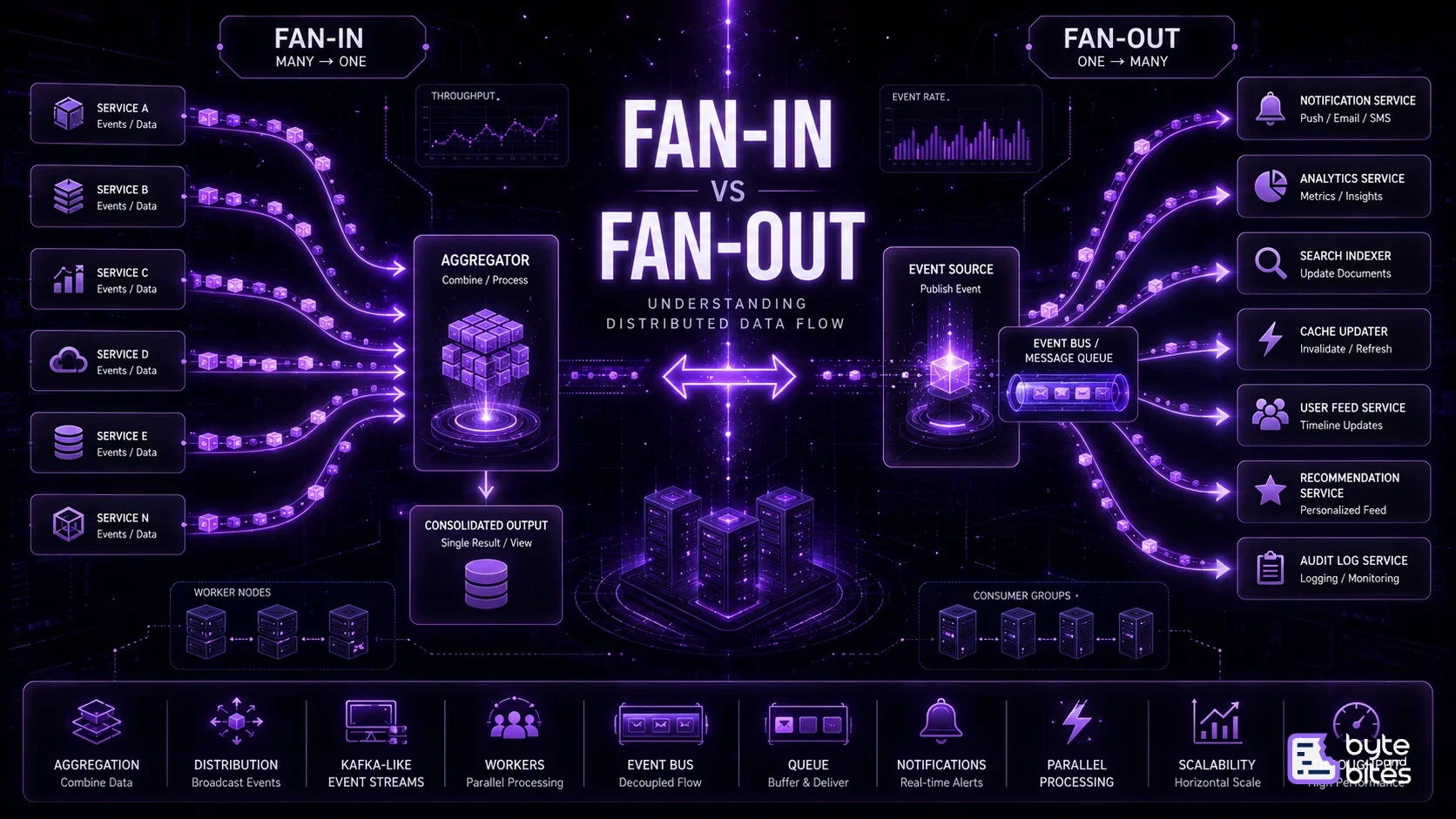
Learn how Fan-In and Fan-Out patterns work in distributed systems with visual diagrams and real-world examples. Understand data aggregation, event broadcasting, messaging, MapReduce, Kafka, notifications, and how these patterns improve scalability, throughput, and system architecture.
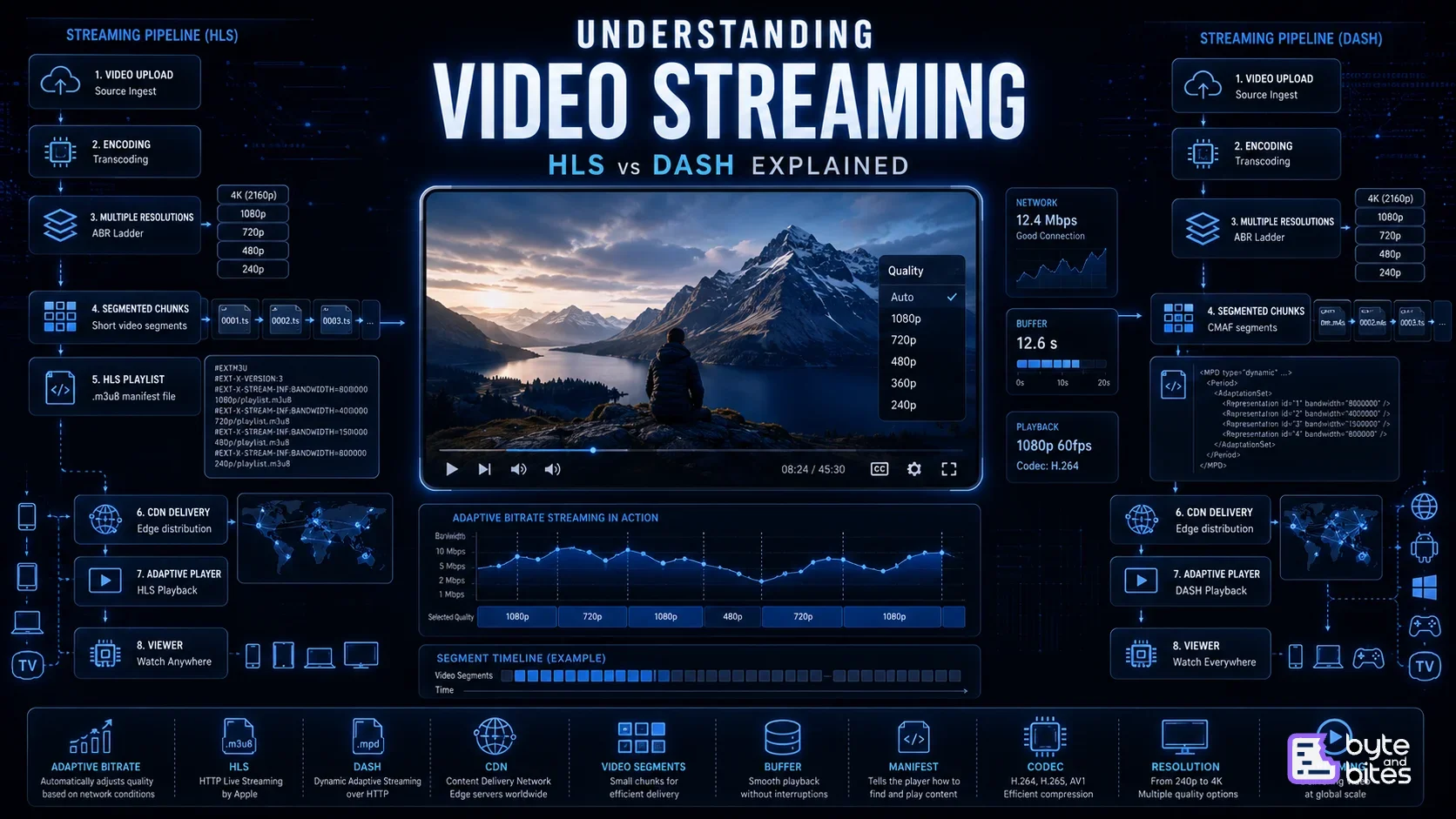
Learn how HLS and MPEG-DASH power modern video streaming platforms like Netflix and YouTube. Understand adaptive bitrate streaming, video segmentation, manifests, codecs, buffering, and how streaming players automatically adjust video quality for the best viewing experience.

Discover what happens after you type a URL into your browser. Follow the complete journey through DNS lookup, TCP and TLS connections, HTTP requests, CDNs, load balancers, servers, databases, caching, and browser rendering to understand how modern websites load in seconds.
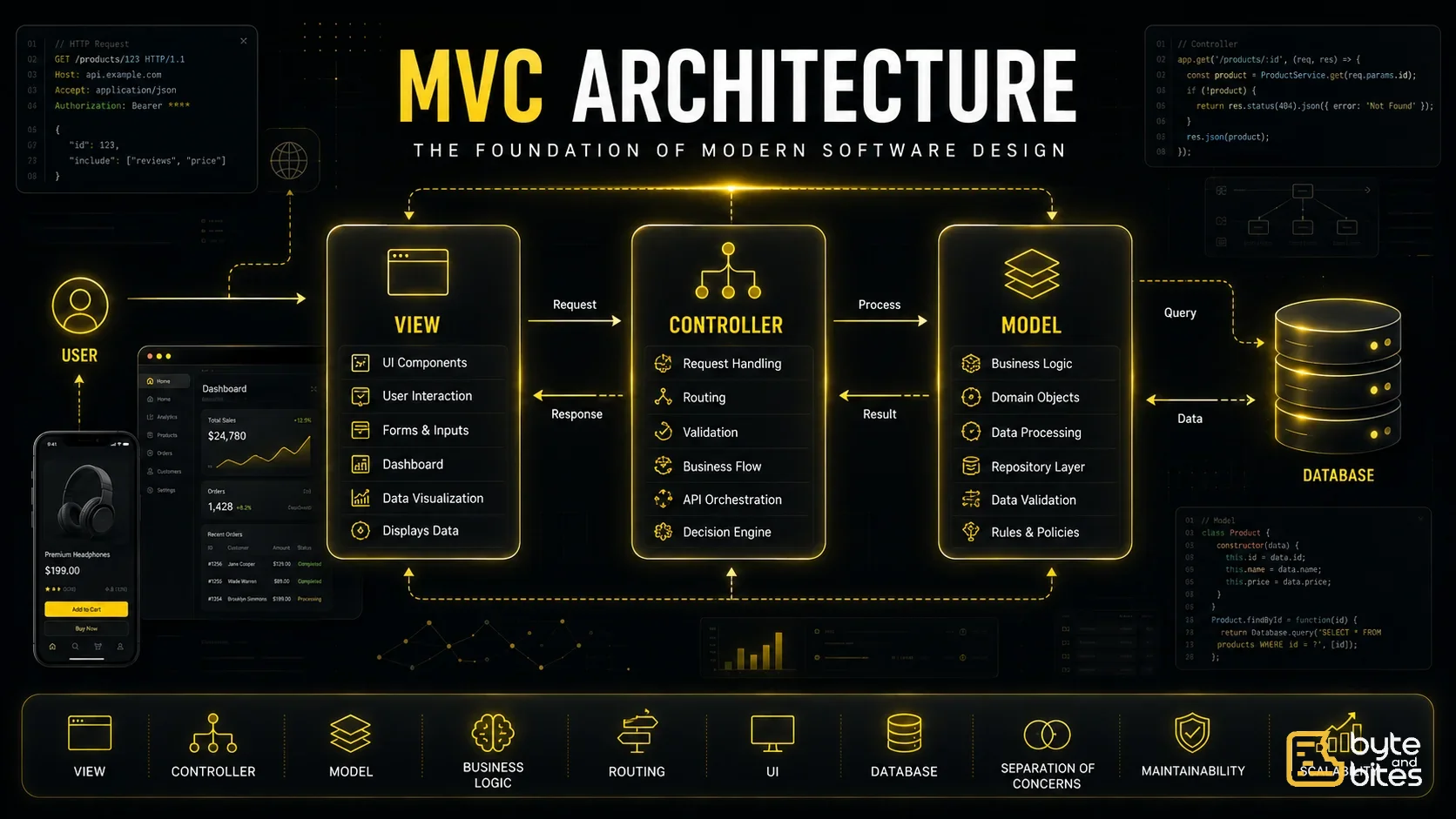
Learn MVC architecture with simple diagrams and real-world examples. Understand how the Model, View, and Controller work together to separate concerns, improve maintainability, and power scalable web and mobile applications using one of software engineering’s most fundamental architectural patterns.